1 Department of Science, School of Technology, Pandit Deendayal Petroleum University, Gandhinagar, Gujarat, India
2 School of Solar energy, School of Technology, Pandit Deendayal Petroleum University, Gandhinagar, Gujarat, India
3 Ultrasound Research Institute (Electrical and electronic Engineering),Kaunas University of Technology, Kaunas, Lithuania
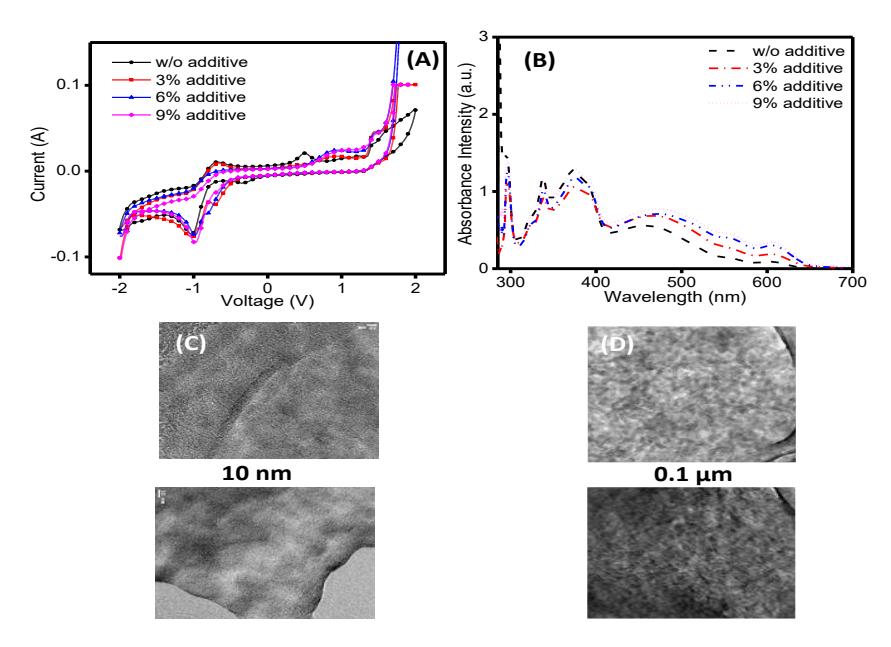
In the present article, the optical, electrochemical and morphological characteristics of the P3HT: Fluoranthene (F5) blend have been studied by using N,N-dimethylacetamide (DMA) as additive. The fluoranthene derivatives are reported as acceptors in organic solar cell (OSC) [1].The focus of this article is to optimize the blend morphology by different parameters such as optical, electrochemical and morphology for the better performance of OSC. 1,6,7,10-tetramethyl fluoranthene (F5) has been synthesized as per the reported procedure [2]. The UV-Visible spectrum of the solution with the addition of solvent additives reveals red shifts in the wavelength which shows a better absorption in the blend and improved local structural order of P3HT [3]. In comparison to pristine solution, the addition of additives causes shift of redox peaks in more positive or negative positions. The curves shows similar redox behavior that indicates additive did not affect the redox reactions and the pairs of redox peaks are consistent. With addition of additive, the cycling performance is significantly improved [4]. The TEM images shows the change in the morphology of the blend with the additive. In the TEM image the brighter phase represents P3HT and darker phase represents F5 moiety. The additive has promoted formation of fibrillar structure in the blend and better phase separation and interpenetrating network. The pristine blend shows large domains, whereas the additive has promoted decrease in the domain size of F5 and forms an interpenetrated network in the P3HT matrix. There is more uniformity and aggregation of F5 which leads to better charge separation and efficient transport of electrons and holes [5].
Fig. 1. (A) CV of pristine with different concentration of additive, (B) UV-Visible spectra of pristine with different concentration of additive, (C) TEM images of blend without additive and with additive at 10nm scale, (D) TEM images of blend without additive and with additive 0.1 μm scale
[1] Zhou Y, Ding L, Shi K, Dai YZ, Ai N, Wang J, et al. A Non-Fullerene Small Molecule as Efficient Electron Acceptor in Organic Bulk Heterojunction Solar Cells. Advanced Materials. 2012;24(7):957-61.
[2] Butterfield AM, Gilomen B, Siegel JS. Kilogram-scale production of corannulene. Organic Process Research & Development. 2012;16(4):664-76.
[3] P. J. Brown, D. S. Thomas, A. Köhler, J. S. Wilson, J.-S. Kim, C. M. Ramsdale, H. Sirringhaus, R. H. Friend, Phys. Rev. B: Condens. Matter Mater. Phys. 2003, 67, 642 031.
[4] Bagheri O, Dehghani H, Afrooz M. Pyridine derivatives; new efficient additives in bromide/tribromide electrolyte for dye sensitized solar cells. RSC Adv. 2015;5(105):86191-86198.
[5] Lee J, Jung J, Emrick T, Russell T, Jo W. Synthesis of C60-end capped P3HT and its application for high performance of P3HT/PCBM bulk heterojunction solar cells. Journal of Materials Chemistry. 2010;20(16):3287.