Recently, tungsten alloys with iron group metals have emerged interest as an alternative to replace electrolytic chromium, which involves environmentally hazardous synthetic procedures. Research on Fe-W alloys is very appealing, since such coatings have a unique combination of mechanical, corrosion and magnetic properties, even at elevated temperatures [1]. From this point of view, Fe-W alloys could be considered as suitable materials for certain micro-/nano-electromechanical systems (MEMS/NEMS).
A series of Fe-W coatings have been electrodeposited from ammonia free glycolate-citrate bath. By changing the electrodeposition condition (i.e., pH, temperature and current density) the W content can be varied from 6 to 25 at.% in a controlled way. Taking into account that the functional properties of material are dependent on its composition the quantitative determination of full composition of electrodeposits (including light elements C, O, H, S, etc.) were performed by means of Glow Discharge Optical Emission Spectrometry (GD-OES). Mechanical properties of Fe-W alloys have been determined using nanoindentation techniques on the cross-section of the specimens, and the magnetic properties alloys have been studied using Vibrating Sample Magnetometer (VSM).
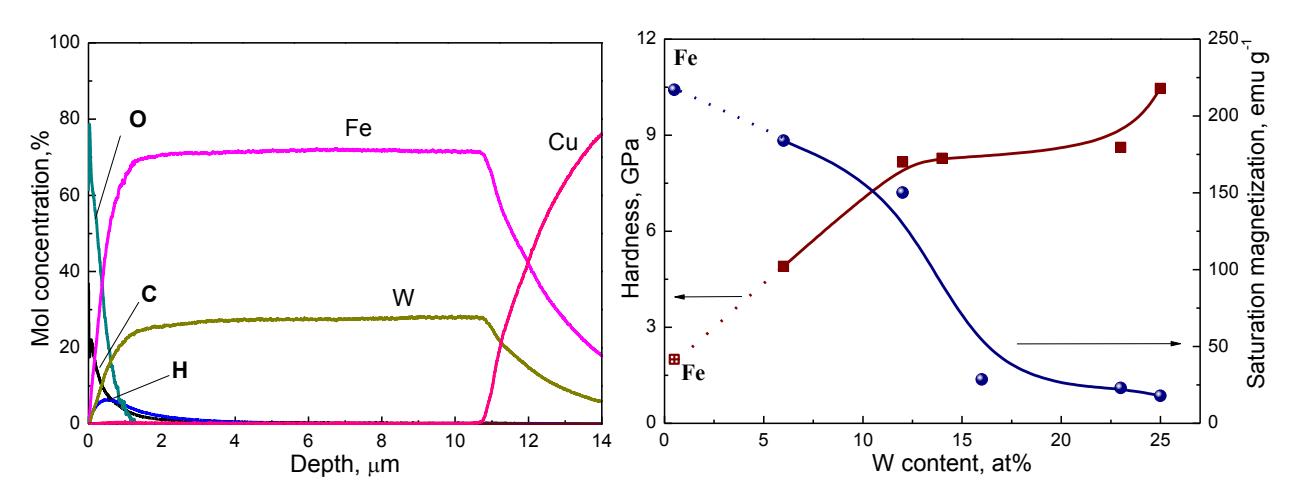
Compositional profiles of 10 μm thick coatings obtained by GD-OES show that the distribution of metals is uniform along the entire film thickness (Fig. 1). Oxygen was found in the coatings up to a depth of 1-2 μm, which indicates the presence of "surface-layer" linked with water/air oxidation of top layer after electrodeposition. XRD analysis showed that the grain size of Fe-W alloys decreases with the increase in W content in the alloys. Thus, the structure of the films transforms from nanocrystalline to amorphous-like. This leads to an increase of hardness, which is as high as ~10 GPa for the alloy with the highest W content. Remarkably, the measured hardness of Fe-25 at.%W is comparable to that of electrolytic chromium [2]. The saturation magnetization Ms, coercivity Hc, and squareness ratio (i.e., Mr/Ms, where Mr is the remanent magnetization) also vary with the W content. As expected, increasing of W content leads to the reduction in saturation magnetization and the coatings become magnetically softer. The mapping of mechanical and magnetic properties of Fe-W alloys is summarized in Fig. 2.