
Development of the organic light emitting diodes, OLEDs, experiences a breakthrough due to recent discovery of novel emission mechanism employing delayed florescence generated by thermal activation (TADF) [1]. The delayed emission is established by virtue of the adjacent triplet energy states, corresponding to a mechanism termed as reverse intersystem crossing (RISC). The TADF process enables to reach 100 % internal quantum efficiency of the singlet luminescence recycling the triplet excitations [2]. In the present study, the ability to control the photoluminescence properties of donor-acceptor triazine-triphenyl-carbazole derivatives as a function of varying para (TTC-p) or meta (TTC-m) position of carbazole substituents was investigated in search of TADF mechanism.
The density functional theory (DFT) calculations revealed twisted molecular conformations (Fig. 1a) for both compounds resulting in a substantial charge transfer (CT) character, and thus a small singlet-triplet energy gap $\Delta E_{ST}$ – a fundamental requirement for the efficient TADF process. Investigation of singlet and triplet spectral distributions in 12 K temperature indicated $\Delta E_{ST}$ of 0.21 eV and 0.13 eV for TTC-p and TTC-m, respectively. Gated intensified charge-coupled camera (iCCD) allowed in depth study of the delayed fluorescence. The emission kinetics displayed in Figure 1b demonstrate normalized intensity kinetics of both TTC derivatives. Although, TTC-p shows higher fluorescence efficiency ($\phi_{FL} = 63\%$), the contribution of delayed fluorescence to the total photoluminescence is minute, whereas almost two thirds of TTC-m emission ($\phi_{FL} = 37\%$) originates from TADF. Furthermore, the measurements of temperature dependency allowed to estimate activation energies $E_A$ for the TADF process, which were found to be 0.2 eV and 0.07 eV for TTC-p and TTC-m, respectively. The noticeable difference between energies $E_A$ and $\Delta E_{ST}$ for TTC-m suggests that intermediate band states play an important role in promoting triplet excitations to singlet state manifold.
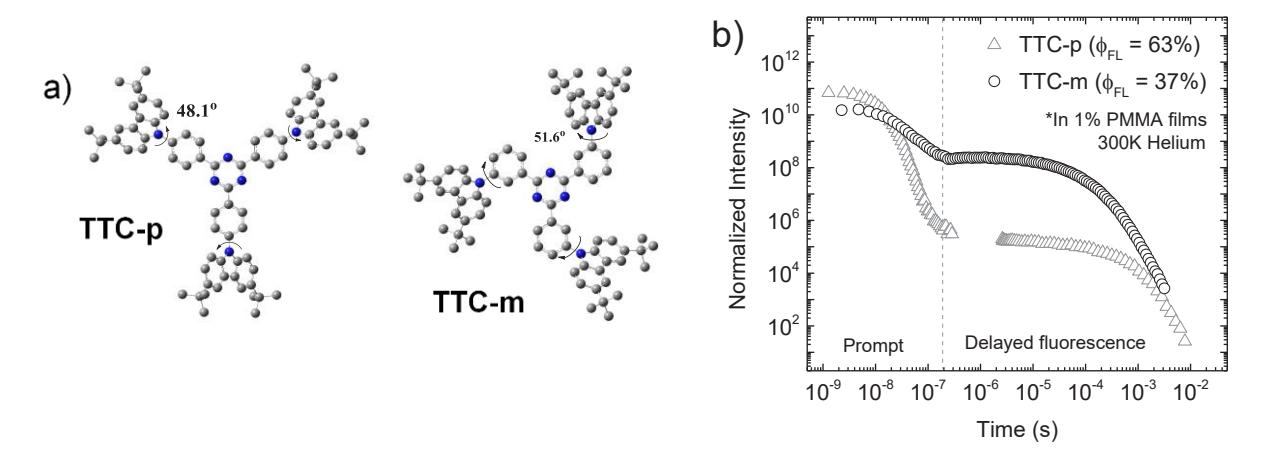
This work revealed the ability to manipulate the photoluminescence characteristics by varying para (TTC-p) or meta (TTC-m) position of carbazole substituents. Meta conformation of donor and acceptor in TTC-m derivative resulted in decrease in the energy gap between singlet and triplet energy states and, therefore, highly increased TADF character in comparison to para conformation (TTC-p). This knowledge is essential in constructing novel chemical derivatives implemented in highly efficient TADF emitters.