
Magnetorheological fluids (MRF) based on micro-sized carbonyl iron particles (CI) and synthetic oil possesses a great interest due to the ability to control their properties, in particular viscosity, by using applied magnetic field. MRF can be easily changed within milliseconds from Newtonian liquid state to semisolid state due to formation of chain-like structures of CI particles which are self-arranged along the magnetic flux. Recently it was demonstrated that the addition of nanosized paramagnetic particles improves magnetorheological characteristics of MRF and their sedimentation stability [1]. Nanosized fraction fills microcavitys between CI particles within the chain (Fig. 1), thus increasing yield stress compared to the basic MRF. MRF are widely used for a number of engineering applications such as dampers and polishing systems.
Magnetite nanorods were obtained by modified template-free solution chemistry method [2]. On the first step Fe(OH)2 was precipitated by the addition of ammonia to FeSO4 aqueous solution. Then, goethite ($\alpha$-FeOOH) nanorods were obtained via oxidation of Fe(OH)2 by KClO3. pH during oxidation was maintained lower than 8.0 to avoid formation of magnetite. After complete oxidation of Fe(OH)2 goethite nanorods were washed with water via centrifugation and dried at 60°C. At the final step goethite nanorods were calcined in furnace under H2 flow at 360°C for 2 hours.
According to electron microscopy and X-ray diffraction well-crystalline magnetite nanorods with 600 nm length and 90 nm thickness were synthesized. Magnetite nanorods possesses significantly higher saturation magnetization (112 emu/g) compared to magnetite nanoparticles (68 emu/g), obtained by the oxidation of Fe(OH)2 at pH > 9. Magnitude of magnetorheological effect mainly depends of saturation magnetization of nanosized addition [1], thus using of nanostructures with shape anisotropy allow achieving a better results. Despite of shape anisotropy (aspect ratio $\approx$ 6) the nanorods demonstrate low coercivity (10 Oe), that makes them to be redisperced after removal of magnetic field.
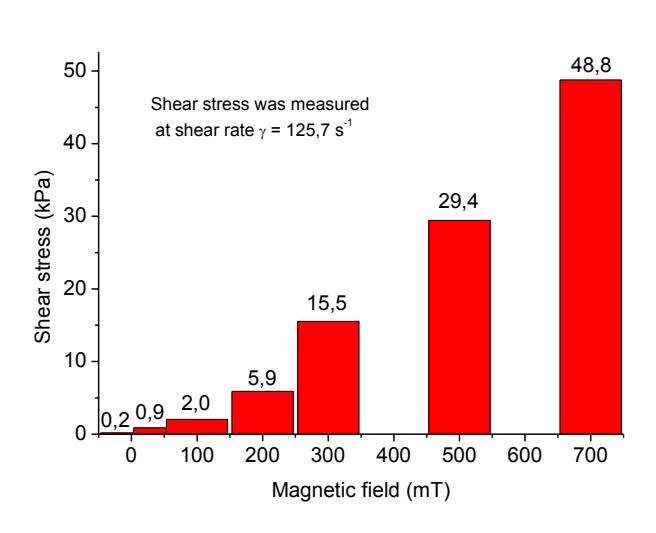
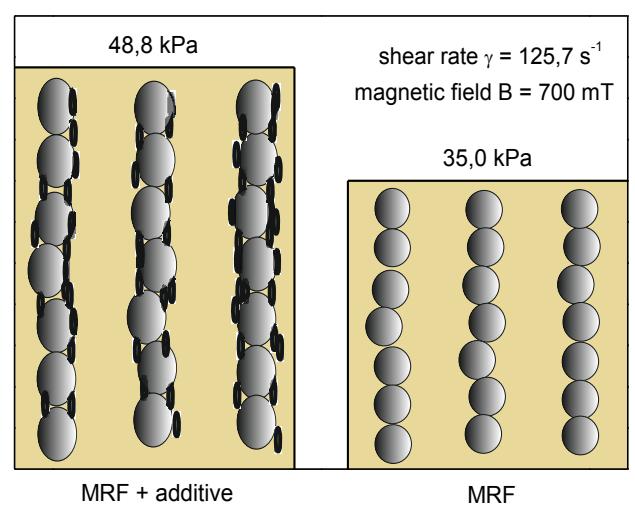
According to the data from fig. 2 the flow resistence at the cell of rotational rheometer increases by 244 times unedr aplying of applied magnetic field (B=700 mT). At the same time, the addition of magnetite nanorods lead to the increase of magnetorheological effectiveness of bicomponent MRF up to 28% compared to basic MRF. Even small additions of nanosized component (1-2 Wt.%) allow to incerase MRF performance. Presented facile template-free synthesis can be used for large scale preparation of nanosized additives for MRF.