
Today, surface enhanced Raman scattering (SERS) is widely used for various applications. One of them is the identification of art materials in objects of cultural heritage. Since huge enhancement of Raman scattering occur in the close vicinity of metal nanoparticle the extraction of the pigment from the paint layer is commonly used treatment technique for SERS applications in Cultural heritage study [1, 2].
Last year gold nanoparticles in toluene were synthesized and approved as SERS-active substrates for art pigments detection [3]. The toluene dissolving organic binders creates the pores in the paint layer. Gold nanoparticles penetrate thought the pores in the paint layer and have a close interaction with art pigments. However, toluene is more suitable to dissolve varnishes and resins. To dissolve oils and fats it is more preferably to use chloroform.
In present work, gold nanoparticles have been synthesized in chloroform. Moreover, the comparing the efficiency of gold nanoparticles prepared via standard Turkevich technique and proposed gold nanoparticles in chloroform have been carried out.
SERS applications have been performed on the microfragments of paint layers from two Belarusian icons. Both of them are from Brest region and correspond to the depiction "Madonna Hodegetria". The icons have similar stylistic features. The cross-section structures are characterized by two layers of ground and one paint layer. Bottom ground layer is red while upper one is white. The pigments in the paint layers are used as mixture.
Gold nanoparticles in chloroform have been prepared by the modified technique after Brust-Schiffrin [4]. Gold nanoparticles were deposited on the top of paints' microfragments without any pretreatments and dried in the horizontal position at the room temperature.
The obtained spectra are characterized with a high signal-to-noise ratio and low luminescence background. The Chrome yellow, Ultramarine blue, Red ochre and Lead oxides were identified in the paints (Fig. 1). It should be noted, in the case of using Au hydrosol the chromophores peaks appear on the huge luminescence background while the using of organic Au sol provides the efficient enhancement of Raman lines along with luminescence quenching.
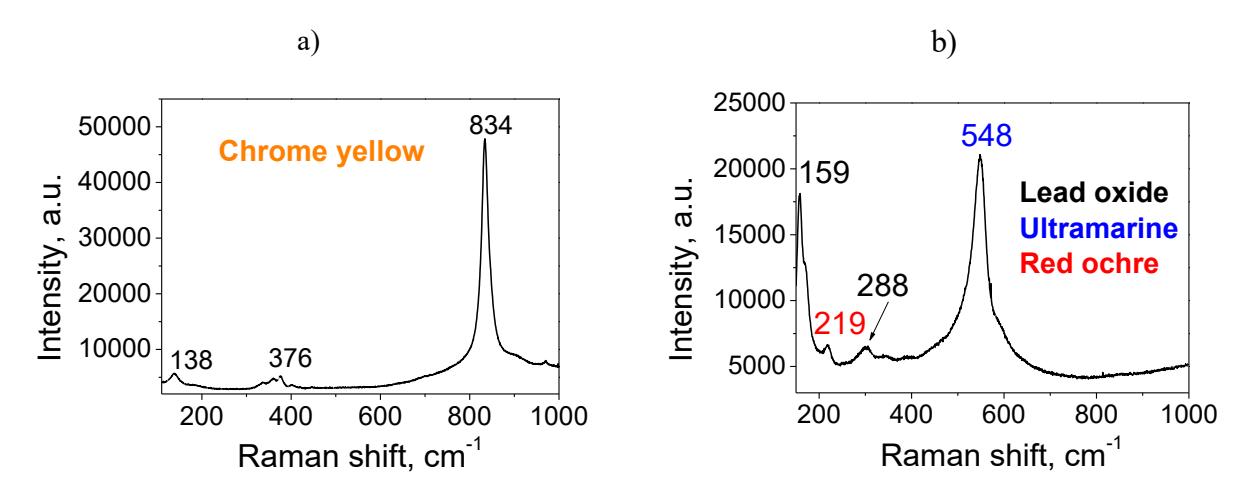
So, the using of gold nanoparticles synthesized in chloroform allow to essentially increase the quality of SERS spectra of art pigments from easel paintings avoiding insistent and time-consuming procedure of sample preparation and could be successfully applied for Cultural heritage study and conservation.