
Stereolithography (SLA) allows rapid and accurate materialization of computer aided design (CAD) models into real objects out of photoreactive resin. Nowadays this technology has evolved to a widespread simple and flexible personal tabletop devices 3D optical printers. However, 3D SLA printers use commercially available resins which are not cheap and of limited applicability, often of unknown chemical ingredients and fixed to certain mechanical properties [1]. In our researche, it is important to have bioresin appropriate to 3D print micro-scaffolds for cell proliferation and tissue engineering. This has encouraged us to study synthesis and photostructuring of organic biomaterials applicable for 3DP technology. The primary chosen substances for photosensitive material synthesis were glycerol diglycidyl ether and epoxidized linseed oil which can be obtained from renewable resources. Both materials polymers can be applied as sustainable photoresins [2]. They are some of the cheapest and most abundant, non-toxic, annually renewable natural resources available in large quantities, with a high content of double bonds making them an ideal component for the preparation of bio-based resins.
Chosen composition was the following: glycerol diglycidyl ether or epoxidized linseed oil, 3,4-epoxycyclohexylmethyl-3,4-epoxycyclohexane carboxylate (30 mol%), photoinitiator (mixture of triarylsulfonium hexafluoroantimonate salts, 50 % in propylene carbonate, 3 mol%). UV lithography was employed to determine its photocross-linking rate and describe processed material properties. Small droplets of the composition were casted on the glass. To ensure that the formed structures after UV (${\lambda}$=365 nm) exposure will adhere to the surface, the droplets were facing downwards. The hydrophilic interaction between glass surface and droplets was strong enough to keep the samples at the substrate. After exposing material to UV radiation through a micro-patterned amplitude mask selective photopolymerization was observed. Acetone was used as a solvent to dissolve UV unaffected area and leaving only formed microstructures on the substrate. The materials were classified according to their: photoreactivity and photomodification selectivity. The resins were compared to FormLabs Form 1+ standard materials, namely Form Clear and AutoDesk Ember PR48.
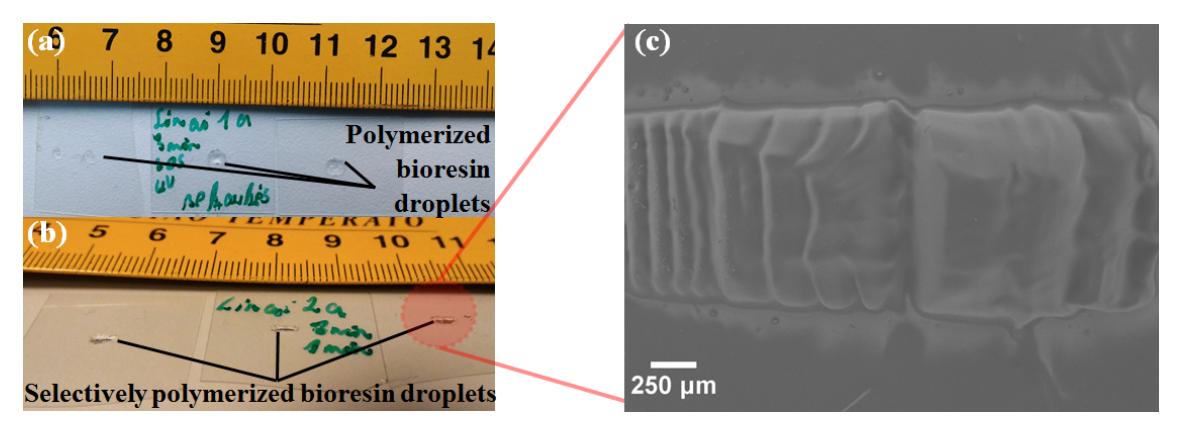
The results show that it is possible to induce photopolymerization reaction in linseed oil-based compositions and to control photomodification selectivity using 365 nm wavelength and 270 mW power light source. However, the composition is less photosensitive than commercial resins, thus it requires prolonged exposure, more powerful light source or additional photoinitiator. It motivates to continue studying photoresins from renewable resources towards 3D laser microlithography applications.