
The term lymphoma describes a heterogeneous group of malignancies with different biology and prognosis. In general, lymphomas are divided into 2 large groups of neoplasms, namely non-Hodgkin lymphoma (NHL) and Hodgkin disease. About 85% of all malignant lymphomas are NHLs1.
NHL includes many clinicopathologic subtypes, each with distinct epidemiologies; etiologies; morphologic, immunophenotypic, genetic, and clinical features; and responses to therapy. With respect to prognosis, NHLs can be divided into two groups: indolent and aggressive2.
Although a variety of laboratory and imaging studies are used in the evaluation and staging of suspected NHL, a hematoxylin and eosin (H&E)-stained section of an excised lymph node is the mainstay of pathologic diagnosis. The treatment of non-Hodgkin lymphoma (NHL) varies greatly, depending on tumor stage, grade, and type and various patient factors2
Despite being one of the most common and well studied cancers, with both well documented diagnostic and treatment protocols, very little is know about epidemiological situation in Lithuania.Data for this study was collected in Vilnius university Santariškės Childrens hospital retrospectively, from case reports of pacients, treated from years 2010 to 2015.Out of 20 histories, 14 met our criteria: children, diagnosed with Non Hodgins lymphoma (NHL), currently juvenile, treated at VULSK Vaikų ligoninė.
20 pacient were diagnosed with NHL, 14 fully met our criteria. Four out of them were girls.(28,5%), 10 were boys (71.5%) Median age at the time of diagnosis 9.57 +- 4.9. Seven reached full remission 7 (50%). NHL was diagnosed in stages I to IV. NHL III st. – 8 (57%), IVst – 4 (29%), I and II st−1 (3.5%). Most common out of all histological subtipes was Burkitts lymphoma 6 (43%), followed by Anaplastic large cell limphoma 3 (22%).
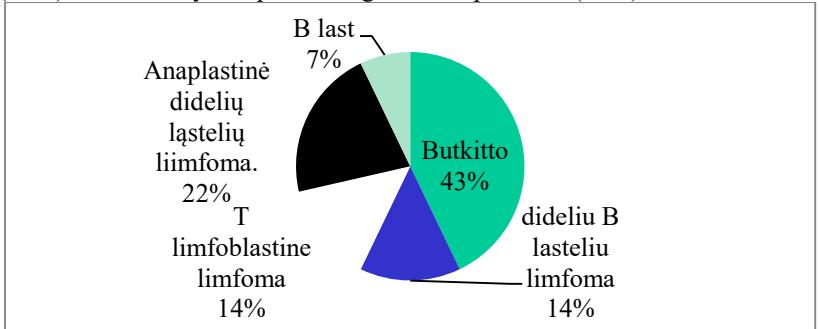
Most common protocol of treatment used was B-NHL-BFM-04 7(50%). Most common symptoms were lymphadenopathy 5 (21proc.). Radiological diagnostic procedures performed 38 KT, 46Ro, 1 PET, 3 MRT, 3 scintigraphies. Most common out of these procedures were head and neck CT, Chest and abdominal CT and abdominal CT, all of which were performed 5 times (5,13%).
In conclusion, dominant first symptom for pacients, with NHL – enlarged lymph nodes. NHL most commonly diagnosed at stage III stadijos.Most common histological type- Burkitt limphoma .Main method of diagnostics-CT