
Electrical stimulation is a rapidly developing method of cellular and tissue engineering. Recently, both cellular and molecular approaches have demonstrated that electrical stimulation can change cell behavior such as migration, proliferation and differentiation [1]. Nevertheless, the relationship between cell response and electrical stimulation remains to be established. We assume electrical stimulation causes changes in transmembrane potential. The membrane potential plays a central role in many essential biological processes and is actively maintained by ion pumps and transporters [2]. In this study, we exposed C6 rat glioma cells in vitro to long-term electrical stimulation with different parameters of electric field and compared resting membrane potentials of cells.
C6 rat glioma cells were cultivated at 37 °C under a humidified atmosphere with 5 % CO2. Stimulation by the external electric field was applied for 12 hours and was launched 8 hours after cell passaging. Electrical stimulation was provided by application of uniform electric field with biphasic stimuli (0.2 ms pulse duration, 10 Hz) of different strength (6 or 20 V/m) and the number of pulses in train (1, 3, 5 or 7) (Fig. 1 A). The measurements of membrane potentials were performed 2 hours after the exposure and were carried out using patch-clamp technique.
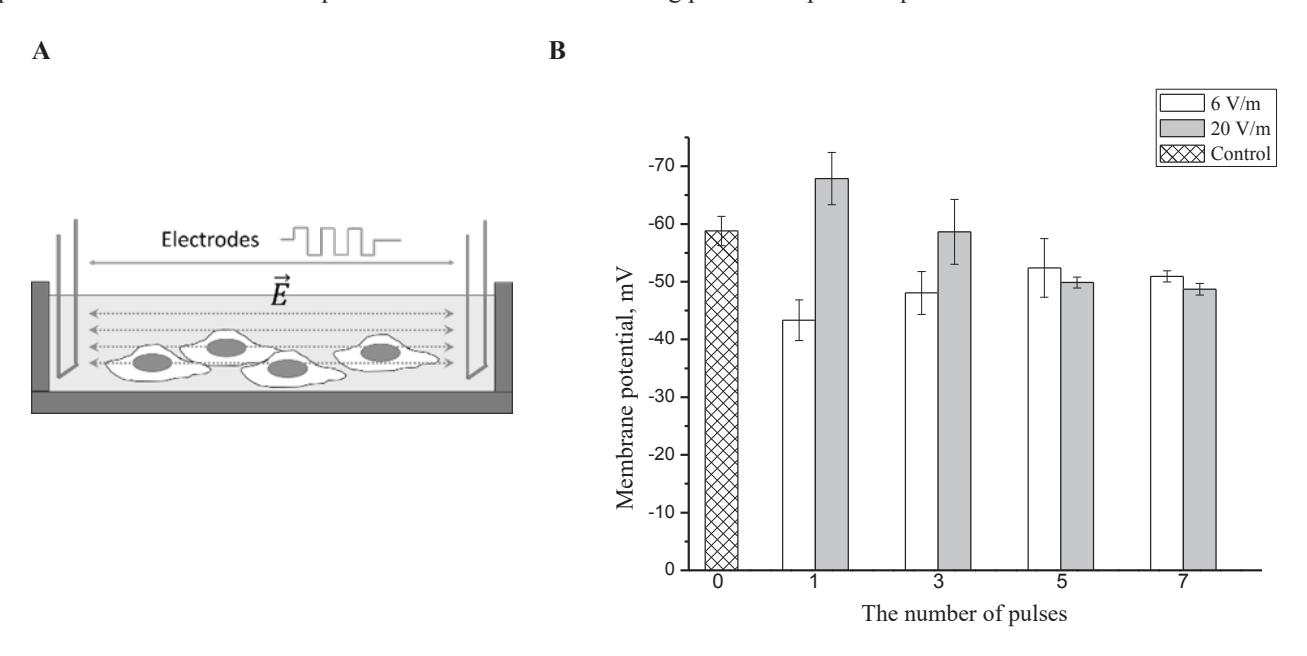
It was found that electrical stimulation of C6 rat glioma cells causes a change in resting membrane potential. The results obtained depend on the number of pulses and electric field strength (Fig. 1 B). Membrane potential tends to the control value with the increase of pulses quantity both at 6 and 20 V/m. At one-pulse stimulation hyper- and depolarisation of membrane is observed depending on the strength of the electric field. The value of resting membrane potential can affect the cell cycle propagation and, consequently, the cell proliferation [3]. Thus, discovered correlation between electrical stimulation parameters and resting membrane potential can be used to develop cell engineering methods.