The renewable energy field constantly looks for improved catalysts for hydrogen evolution and solar energy conversion reactions. Various semiconductor materials can be applied, but a common issue is a large band gap energy. This usually limits photocatalytic activity of materials in the visible light range. However, some transition metal sulfides exhibit lower band gaps, and are being explored as potential photocatalysts. One of them is MoS2 having a band gap of ~1.7eV.
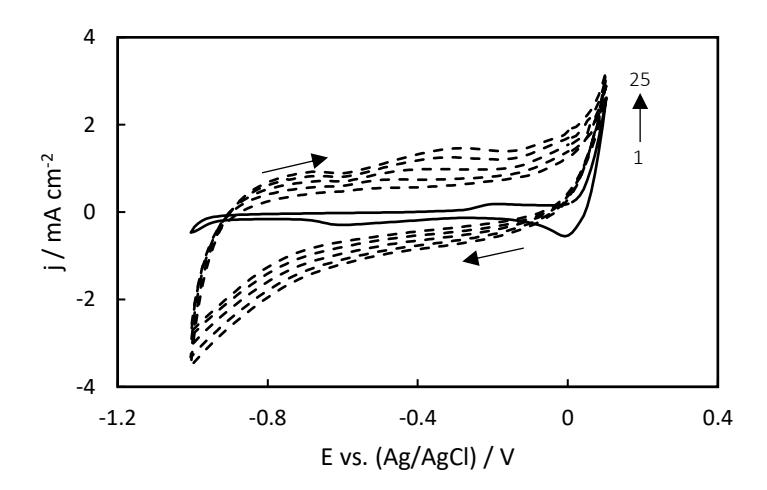
Although other methods exist, this study was aimed at obtaining molybdenum sulfide films by electrodeposition technique. This methodology has been proposed in other studies [1,2] as well, there precursor tetrathiomolybdate / MoS42- is used as a source of both sulfide and molybdenum ions in the deposition bath. We chose copper as the substrate and performed cyclic voltammetry in a 40 mM MoS42- solution to film deposition. A control test performed in 0.1M Na2SO4 solution (see Fig. 1. solid line) showed anodic and cathodic peaks, possibly caused by the formation of copper oxides but the current was otherwise stable. Upon addition of tetrathiomolybdate current densities increase significantly. After 25 cycles a broad peak at -0.3 V became apparent, which indicates the anodic deposition of amorphous MoS3. When the potential is scanned cathodically film dissolves in part and a reductive deposition of amorphous MoS2 can occur.
Films obtained by potential cycling are nonstoichiometric MoSx. Potentiostatic cathodic and anodic depositions are also possible, although the use of anodic potentials on copper is hindered by a sharp increase in current at 0.1 V and films exhibit poor adhesion. The obtained molybdenum sulfide films have also been tested for photocatalytic activity.