
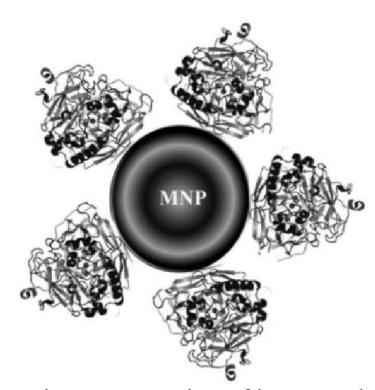
This study focuses on the direct binding of laccase from Sclerotinia sclerotiorum to magnetic nanoparticles (MNPs) and the investigation of adsorption characteristics, activity and kinetics of bound laccase (Fig. 1). The use of magnetic nanoparticles as a support for immobilized enzymes has advantages, such as high surface area for the binding of a large amount of enzymes and the selective separation of immobilized enzymes from a reaction mixture by the application of an external magnetic field [1, 2]. The laccase attachment to magnetic nanoparticles takes advantage of this enzyme in various biotechnological applications.
Magnetic nanoparticles were preapared by following the procedures described in [3]. Atomic force microscope was used for nanoparticles characterization. The size distribution of synthesized magnetic nanoparticles is 30–48 nm with a mean size of $39 \pm 5$ nm.
The activity and kinetic parameters of bound and native laccase were determined spectrofotometically by measuring increase of absorption at 414 nm resulting from oxidation of 2,2'-azino-bis(3-ethylbenzothiazoline-6-sulphonic acid) (ABTS).
The adsorbtion was performed by incubating the laccase solution with magnetic nanoparticles for 10–110 minutes. After the incubation the MNPs with adsorbed laccase were separated by applying external magnetic field and the activity of the enzyme on the resuspended MNPs and in the supernatant was determined. During the incubation 6–27 % loss of activity of the enzyme was observed. The residual activity in the supernatant and the activity of the adsorbed enzyme depended on the ratio of the laccase and MNPs in the incubation mixture. The amount of adsorbed laccase on magnetic nanoparticles was from 0.41 μU/μg to 2 μU/μg if the ratio of enzyme and MNPs in incubation mixture was from 0.69 μU/μg to 3 μU/μg, respectively.
Desorption of laccase from the magnetic nanoparticles was investigated by seperating the MNPs with adsorbed laccase and resuspending them in DI water or buffer solution several times. The amount of desorbed laccase depends on the resuspending media and the number of repeated procedures. The residual activity of laccase after 10 times of desorption procedure in water or buffer solution was 58 % or 31 %, respectively.
The kinetics of ABTS oxidation with immobilized laccase were investigated and the parameters were calculated by applying the ping-pong scheme of the enzyme action [4]. The apparent values of Michaelis-Menten constant ($K_m$) were determined to be $14 \pm 3$ μM for the native enzyme and $51 \pm 4$ μM for the immobilized enzyme. The values of bimolecular constants of the enzyme reactivity with oxygen and ABTS decreased for the adsorbed enzyme in compare to native enzyme. The change of the values suggest the adverse orientation and restricted accessibility to substrates of the adsorbed enzyme.