Solar cells are expected to be one of the key future technologies of environmentally friendly electric energy generation. For this purpose, group III-V element compounds are particularly favourable due to their flexible bandgap. It is especially important taking into account spectral energy distribution of solar radiation which extends to infrared regions - this is where narrow - gap semiconductors prove to be useful. InN with a band gap of about 0.7 eV is a promising material to be used in tandem solar cells to enhance their photovoltaic conversion efficiency. However, there is a large number of difficulties related to producing high quality InN films, with the most common being lattice mismatch between the semiconductor layer and the corresponding substrate, high thermal instability of InN and reactions with atomic hydrogen.
In this work we investigate InN samples grown by metalorganic chemical vapour deposition (MOCVD) on c-sapphire substrates under different conditions. Growth parameters such as growth temperature, growth pulse and pause duration as well as growth pulse count were varied. The samples were investigated at room temperature using pump-probe technique. Excitation was carried out with the 1st harmonic (1030 nm) of the Yb:KGW femtosecond laser (PHAROS), while for probing the wavelength was tuned to 2400 nm with optical parametric amplifier (ORPHEUS). The repetition rate of 250 fs laser pulses was set to 3 kHz.
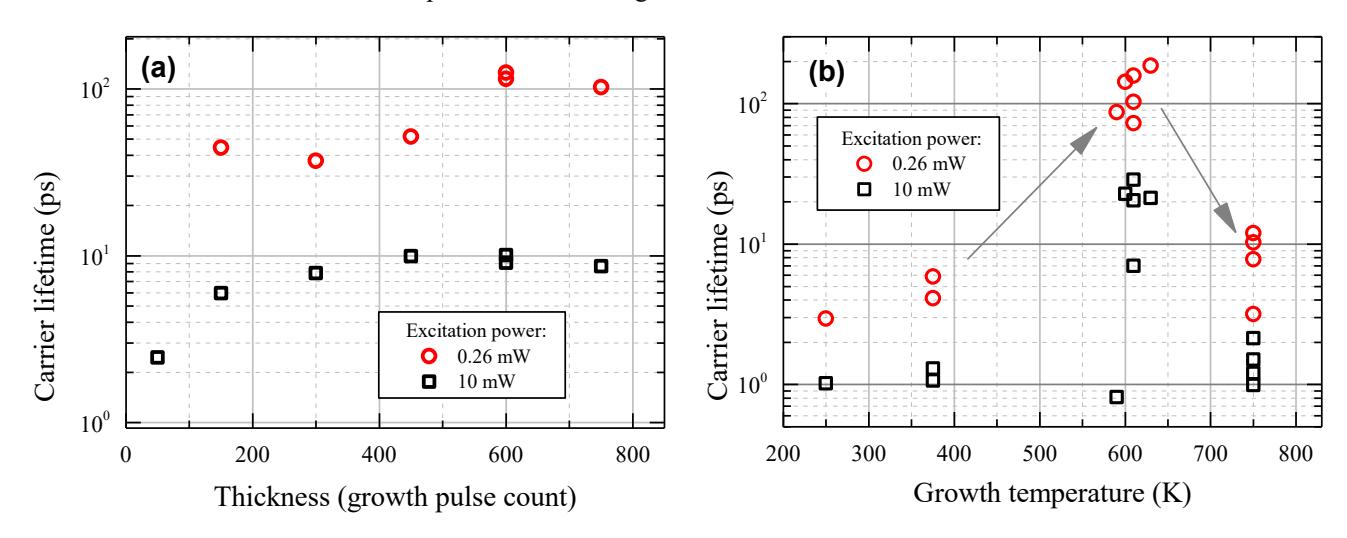
Carrier lifetimes were used to evaluate the samples with the optimal growth conditions, as longer lifetimes usually indicate lower presence of defects in the crystal lattice, hence better overall quality. Direct relation between the sample thickness and non-equilibrium charge carrier lifetime was observed – higher number of growth cycles resulted in longer lifetimes (Fig. 1a). The increase of the thickness was confirmed with a higher initial pump-probe signal. The results also indicate that the optimal temperature for growing InN-based structures is around 600 K (Fig. 1b). Optimal growth pulse duration was found to be 7 s, with the pause duration being 20 s.