
Nonlinear photonic crystals are structures with spatially modulated quadratic nonlinearity [1] offering new possibilities to manipulate the nonlinear three wave interactions in a desired way. Naturally grown disordered polycrystalline materials consisting of a large number of single crystal domains with random orientations, random shapes and random sizes, represent a peculiar class of nonlinear photonic crystals, often termed as random or short-range order nonlinear photonic crystals. The so called “random quasi phase matching”, which stems from the disorder of the nonlinear domains [2], greatly extends the fundamental limits of frequency conversion that are imposed by the phase mismatch between the interacting waves, without any additional adjustments. Due to greatly relaxed phase matching conditions, random quasi phase matching allows to phase match any second-order process, therefore enabling a broadband frequency conversion within a wide spectral range, with the limitations of the bandwidth being imposed just by the transparency window of the material.
In this contribution, we investigate self-focusing and filamentation of intense wavelength tunable (in the 1.6 – 2.4 μm range) femtosecond pulses in polycrystalline ZnSe. We observe ultrabroadband supercontinuum (SC) generation in the 650 – 4200 nm range, which is accompanied by efficient simultaneous broadband generation of the second, third and fourth harmonics via randomly quasi-phase matched three wave mixing (Fig. 1).
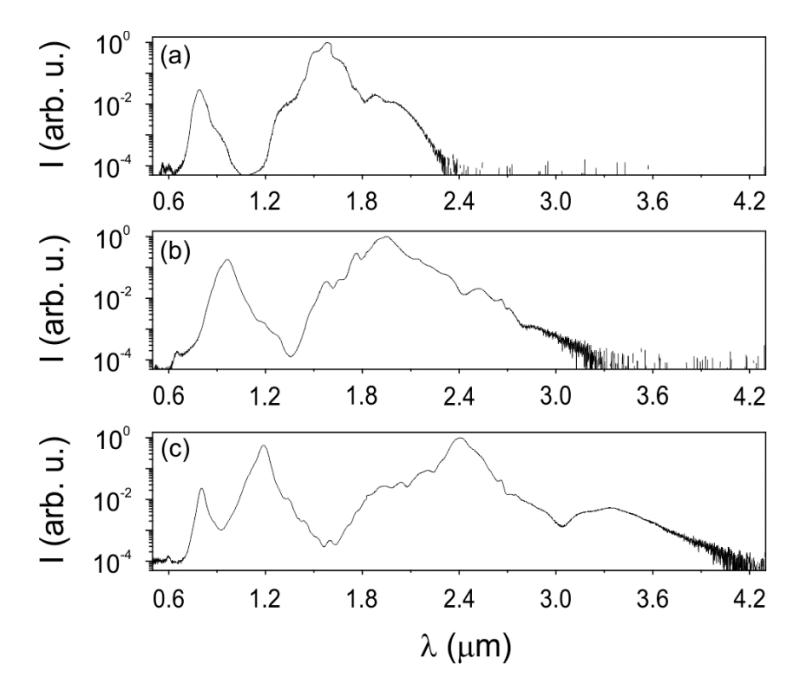
As confirmed by the near-field intensity measurements, we have accessed both, single and multiple filamentation regimes with the latter possessing exceptionally stable and reproducible patterns, which emerge regardless of the chaotic nature of the process. Moreover, we uncover a number of interesting features regarding the efficiency and polarization of the second and third harmonic generation. First of all, the measured second and third harmonic conversion efficiencies reach up to 20% and 1% respectively, which are the highest values ever achieved in randomly quasi phase matched interactions. Secondly, we show that in the single filament regime the measured second and third harmonic conversion efficiencies follow the expected linear dependence on the sample length [3]. Finally, we demonstrate that as a result, of random orientation of the individual crystallites, the second and third harmonic radiation possess a random polarization, whereas the SC retains the linear polarization of the incident pulse, We believe our findings open fascinating prospects for randomly quasi phase matched interactions in the rapidly developing field of ultrafast mid-infrared nonlinear optics.