
Recently, ultra-small gold nanoparticles and clusters have attracted considerable attention due to their unique catalytic, optical and electronic properties such as strong fluorescence, vis light absorption and as large as 1.77 eV energy gaps. Besides, due to biocompatibility and size as well as stabilizing shell-dependent fluorescence, gold clusters hold great potentials in biological applications and nanomedicine.
Among others, gold clusters, synthesized during past several years using proteins, such as bovine serum albumin [1], lactoferrin [2] and lysozyme [3] and possessing red-luminescence with lifetimes up to several micro seconds, good stability, non-toxicity and biocompatibility, can be used for cancer cells imagining and target detection.
Recently we have found a new class of protein-based cheap reducers, particular some food supplements, for formation of red-luminescent gold clusters under blue and green light excitation with a good quantum yield (7%), lifetime up to 2 μs and stability for month. These characteristics are close to Au nanoclusters (AuNCs) synthesized and stabilized with BSA (AuNCs@BSA). The first tests in Lithuania National Cancer Institute have shown that these clusters tend to accumulate in more tumorigenic breast cancer cells (line MDA-MB-213) and can be prospective for bio imagining. To full understanding the composition of our clusters as well as stabilizing shells, high-resolution mass spectrometry characterization is crucial.
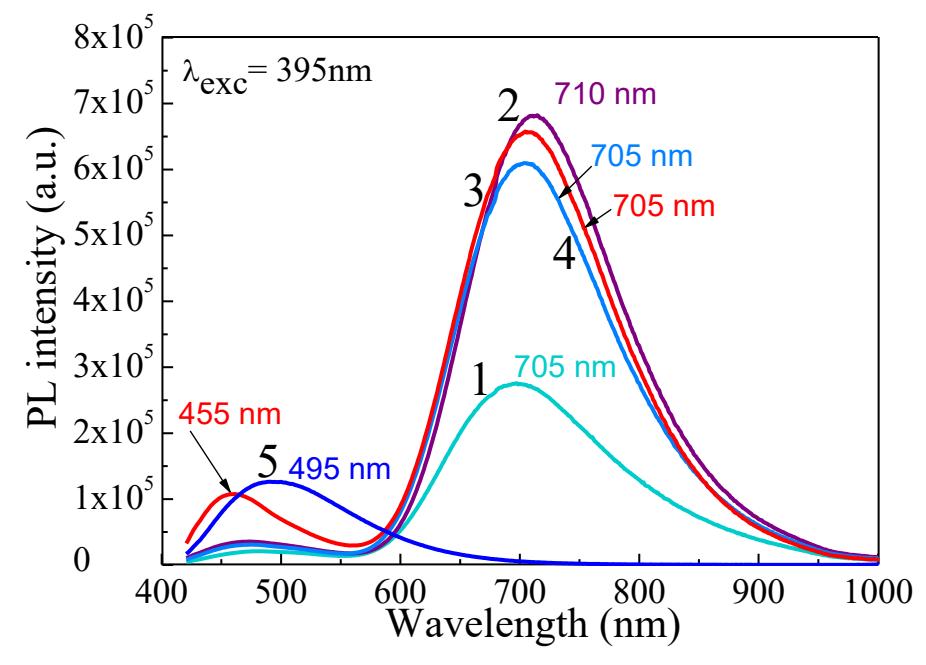
In this study that addition of some amino acids to the synthesis solution of BCAA'S and chloroauric acid can significantly increase or decrease the PL intensity of the synthesized NCs (Fig. 6) and the yield of red-luminescent gold clusters. The most effective influence was obtained using leucine, serine and glutamic acid whereas the addition of cysteine hindered the formation of red luminescent gold NCs. On the other hand, the addition of cysteine resulted in the formation of blue fluorescent gold clusters possessing emission peak at 495 nm (spectrum 5 in Fig. 6).