Polycrystalline manganite thin films exhibiting colossal magnetoresistance (CMR) phenomenon are promising materials for the fabrication of B-scalar sensors measuring high pulsed magnetic fields independently on field orientation [1, 2]. The demand of these sensors is increasing with the development of high pulsed magnetic field generation and application possibilities. Polycrystalline manganites with perovskite structure are good candidates for such applications.
The conductivity of La1-xSrxMn1+yO3+δ (LSMO) films was investigated in a wide temperature range (5-310 K). The films were deposited at a temperature of 750 °C on a polycrystalline Al2O3 substrate using a Pulsed Injection Metal Organic Chemical Vapor Deposition (PI MOCVD) technique. The Sr content $x$ was changed from 0.0545 to 0.2637, while keeping manganese excess constant ($y$=0.15). The magnetoresistance of the films was investigated in permanent magnetic field up to 0.7 T and pulsed magnetic fields up to 20 T in a temperature range (77-290 K).
It was demonstrated that these films having Mn excess of 15 % exhibit phase transition from paramagnetic to ferromagnetic state for all investigated Sr content $x$. The maximum of their resistivity decreases with increase of Sr content $x$, while it corresponding temperature Tm has a maximum at $x$≈0.18.
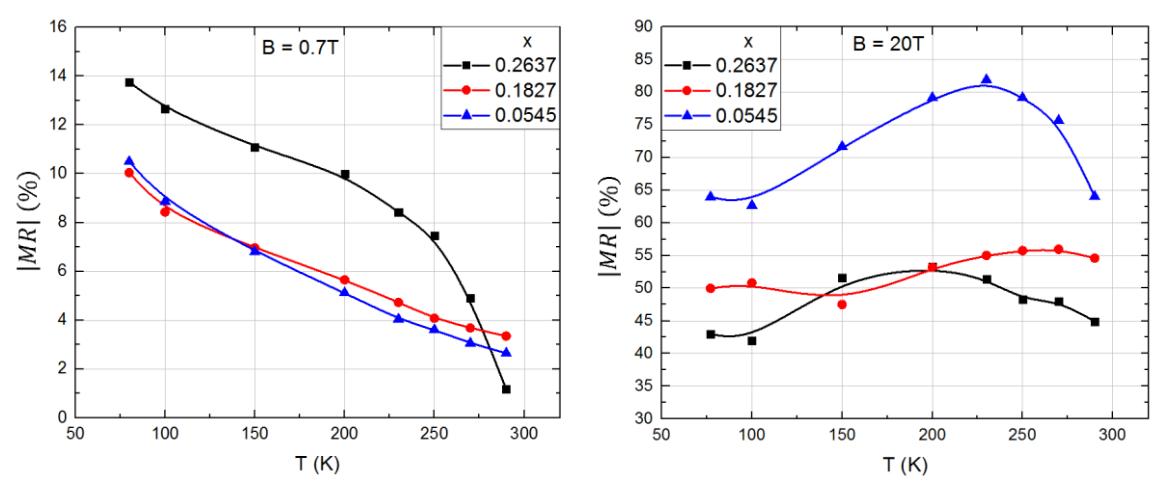
It was found that at room temperature the magnetoresistance at low magnetic fields (0.7 T) is largest for the films with $x$=0.1827. The magnetoresistance of the film with lowest $x$=0.0545 rapidly increases with decrease of temperature and becomes highest compared with other films at temperatures lower than 270 K (Fig. 1, left). The magnetoresistance in high magnetic fields (20 T) is largest for the films with $x$=0.0545 in the whole investigated temperature range.