
Gallium nitride (GaN) is a promising material for application to particle detectors in a harsh radiation environment at the Large Hadron Collider (LHC) and other particle accelerators [1]. In this study, the structures of capacitor-type detector have been fabricated on high crystalline quality semi-insulating bulk ammono-thermal GaN (AT GaN) materials. The operational characteristics of sensors have been investigated by pulsed current techniques. The measurements of photoconductivity and photoluminescence transients were also performed to estimate the variations of non-radiative and radiative recombination parameter, respectively.
In this study, fluences dependent variations of carrier recombination lifetime have been examined by means of microwave probed photoconductivity (MW-PC) transients. The time integrated and time resolved photoluminescence measurements were performed to study the dynamics of carriers related with radiative recombination processes in samples of the pristine and irradiated with different neutron fluences (1012 - 5×1016 cm-2) GaN material. The charge collection efficiency (CCE) characteristics have been studied by inspection of current transients recorded on capacitor-type sensor.
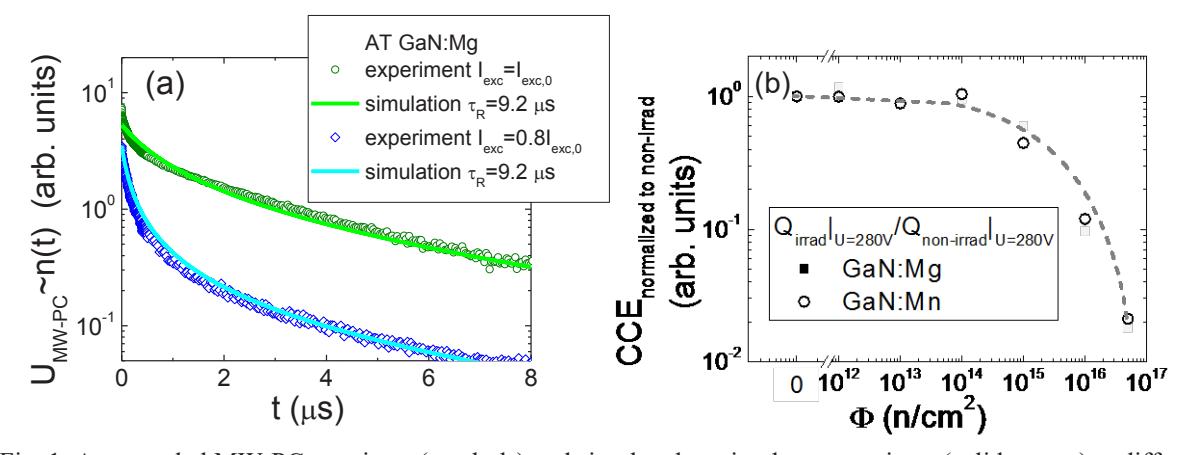
The as-recorded and simulated MW-PC transients obtained at different excitation intensities are compared in Fig. 1a. Carrier recombination lifetime $\tau_{R}$ can be a measure for characterization of the non-radiative recombination defects It has been determined that a radiative recombination coefficient $B= 2\times10^{-8}$ cm3/s should be assigned to the UV (band-to-band) recombination process. Study of the CCE characteristics dependent on neutron fluences revealed that efficiency decreases with increasing of neutron fluences as shown in Fig. 1b. Degradation of CCE can be explained by the increased density radiation of defects in GaN materials due to heavily neutron irradiation.
The time-integrated photoluminescence (TI-PL) spectra, obtained for the neutron irradiated and pristine AT GaN:Mg by using integration time of 50 ns and 500 ns, consist of three bands: UV-PL assigned to excitonic or band-to-band luminescence, B-PL and YG-PL assigned to donor-acceptor pairs (DAP). Variations of the TI-PL transients exhibited the non-exponential two-componential PL relaxation. Such PL transients might be inherent for the radiative carrier recombination processes due to DAP [2]. The longest instantaneous PL decay times have been observed in YG-PL while the fastest decay appeared in UV-PL spectral range.