Self-assembled monolayers (SAMs) on metal surfaces can serve as useful models for analysis of the interaction of functional groups of amino acids with ions, solvent molecules, biomolecules, and other components. In particular, the effect of electric field on the structure and spectral properties of the functional group is important for understanding the function of biomolecules. To probe the structure of phenylalanine ring at different conditions, we have synthesized the thiol molecule with terminal phenyl-ring and intrachain amide group (MOPHE, N-(2-phenylethyl)-8-sulphanyloctanamide). In this work, we studied the effect of electrochemical potential on the structure of monolayer by using the surface enhanced Raman spectroscopy (SERS).
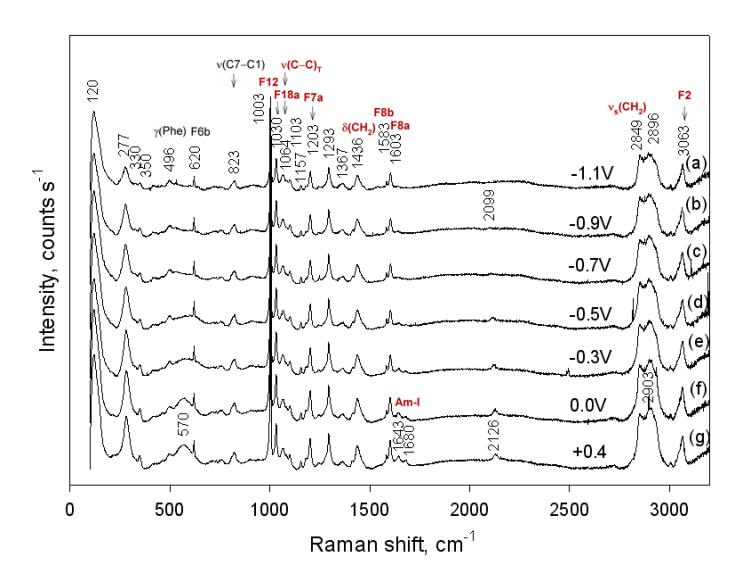
Fig. 1 shows the potential-dependent SERS spectra from MOPHE monolayer self-assembled on gold electrode surface. Defined bands of MOPHE phenyl ring were observed in SERS spectrum at 496 ($\gamma$ Phe), 620 (F6b), 823 ($\nu$C7-C1), 1003 (F12), 1030 (F18a), 1064 ($\nu$C-C)T, 1103 ($\nu$C-C)T, 1203 (F7a), 1436 ($\delta$CH2), 1583 (F8b), 1603 (F8a), 2849, 2896 $\nu$s(CH2), and 3063 (F2) cm-1 [1]. The intense band near 1064 cm-1 is due to C-C stretching vibration of alkyl chain in all-trans conformation [2]. Thus, monolayer is well-ordered and exhibits alkyl chain in extended trans configuration. The low intensity band near 1643 cm-1 was assigned to Amide-I (Am-I) vibrational mode. The main contribution for Am-I mode comes from the C=O stretching vibration. Relatively low frequency of this band indicates involvement of intrachain amide group in strong hydrogen bonding interaction. Such interaction might be responsible for the stabilization of the monolayer. The low frequency band near 277 cm-1 corresponds to metal-adsorbate stretching vibration $\nu$(Au-S) [2]. Presence of this band provides direct evidence on formation of covalent bond between the thiol and gold substrate. One can see (Fig. 1) that the monolayer is stable in the wide potential region (from -1.1 to 0.4 V vs. Ag/AgCl electrode). Relative intensity of the SERS bands provides information on orientation of functional groups with respect to the electrode surface. Thus, intensity of $\nu$(Au-S) increases at more positive electrode potentials. This might be associated with more vertical alignment of Au-S bonds. Slight increase in relative intensity is also visible for the ring C-H stretching mode near 3063 cm-1 indicating more vertical orientation of phenyl-ring at more positive electrode potentials.