Organic semiconductors let us build high-tech gadgets, which would be impossible with the ordinary, inorganic materials. The new era of the flexible, transparent, and even more biological environment friendly devices has arrived. The hardest task for the physicists and chemists is to make organic semiconductors reach the characteristics of the inorganic ones. Scientists are not giving up not only because organic materials let us have the amazing gadgets in our everyday life, but they also are seeking for a simpler and cheaper production. [1]
One of the conjugated derivatives - 1,8-naphthalimide - is a widely used molecule, which emission colour can be changed by adding different moieties at C-4 position. 1,8-naphthalimide compounds generally have high electron affinity and are very sensitive to the medium polarity. These molecules with the good electron-transporting moieties can be used in fields such as medicine, biology, dyes, organic optoelectronics, sensors, etc. [2]
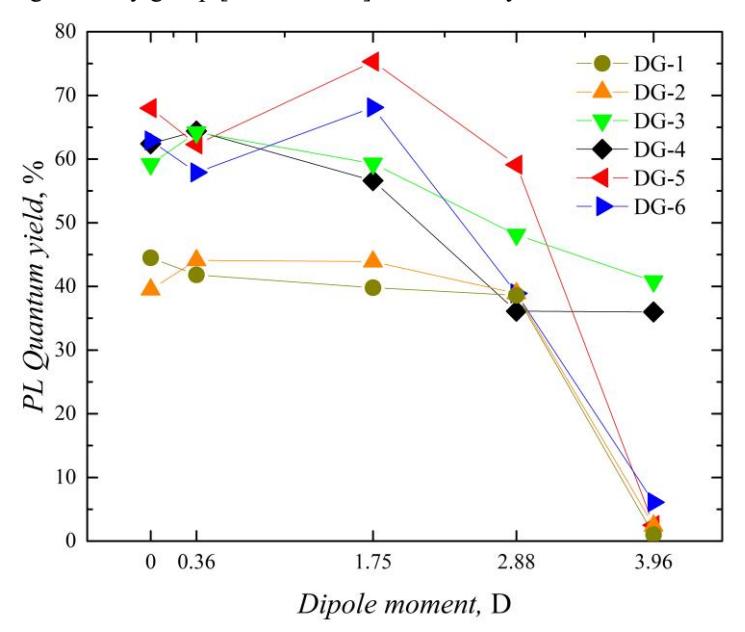
In this work we investigate photophysical properties of donor-acceptor systems composed of 1,8-naphthalimide with six different moieties linked through acetylene bond at the 4th position. This study includes analyzing of the absorption and photoluminescence (PL) spectra, PL quantum yield and PL decay. The absorption and fluorescence spectra of studied compounds in the different polarity (0 – 3.96 D) solvents revealed intramolecular charge transfer states [3]. The results showed a wide range of Stokes shift (16 – 203 nm), which confirms a strong solvation of the derivatives. Moreover, the PL quantum yields seem to be independent of medium's polarity for molecules with biphenyl [DG-3] and naphthalene [DG-4] moieties (Fig. 1.). The highest PL quantum yields were estimated for the derivatives with electron donating methoxy group [DG-5, DG-6] in the tetrahydrofuran solvent.