
Modeling of emotions in technical systems is a mathematical representation of properties and qualities of emotional conditions of the human for the purpose of the analysis of the proceeding processes in case of expression of emotions. For creation of effective system of the analysis of an emotional condition of the human it is necessary to formalize a concept of emotion – to determine its parameters and properties from the mathematical point of view.
According to Osgood, Suci and Tannenbaum's theory [1] and subsequent psychological research [2], the emotion computing can be conceptualized as three major dimensions of connotative meaning: tone, sensibilization and manifestation. Regarding the three dimensions as axes, a space of emotion can be modeled (Fig. 1).
During the development process of emotion model, the most important criteria were elaborated: completeness, high performance from the computing point of view, high adaptability under certain types of tasks. The structure of the developed formalized information emotion model is shown in the Figure 2 which essence consists in representation of emotional coloring of the analyzed video or the image as superpositions of the basic parametrized types of emotions for the further obtaining generalized characteristic of emotional coloring. Decomposition of emotional coloring of the analyzed image of a human face on the components from the allocated (basic) types of emotions is carried out by means of the qualifier of an emotional condition of the human on his face expressions.
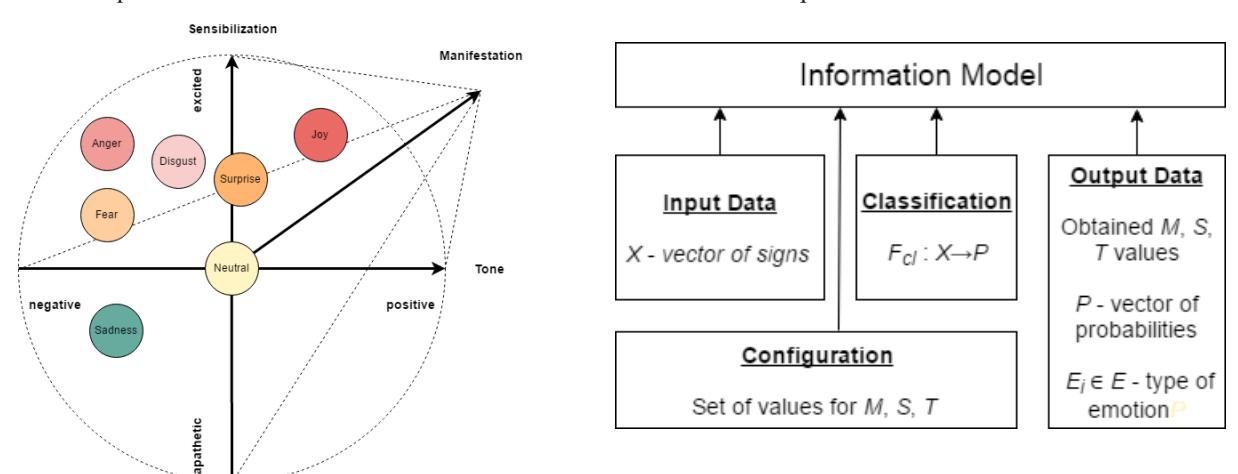
The key input parameter of the presented model is the vector of signs X, received on the basis of digital processing of the image of a human face in the analysis of change an arrangement of the defined points on him characterizing dynamics of reduction of the face muscles which are responsible for expression of this or that emotion. The key output parameter is the vector of P, which reflects information on probability of compliance of a facial expression to a certain type of emotion from the set of the considered emotions of E, and represents such vector that for his elements the following equality is carried out:
$$ \sum_{i=1}^{E} p_i = 1 $$where $p_i$ – is an element of a vector of P, representing probability that the analyzed image corresponds to type of emotion $E_i \in E$. Elements of a vector of P represent coordinates of the analyzed emotion in multidimensional space where the single basic vector corresponds to the separate marked-out emotion. The $E_{res} \in E$ parameter corresponds to emotion type which is appropriated to emotional coloring of a face after its analysis Value of output parameters T (Tone), S (sensibilization) and M (manifistation) are proceeding from results of classification of emotion and can be used for additional informational content. Functional dependence of $F_{cl}: X \to P$ carries out display of values of a vector of signs of a facial expressions to a vector of probabilities of P. The qualifier, which is based on the training data is used for such functional display.
As a result, the similar theoretical base allows implementing process of the analysis of an emotional condition of the human on his face in the form of the sequence of methods of processing and the analysis of the entrance image of a human face.