
Optical sensing, based on the process of triplet-triplet annihilation photon energy upconversion1 (TTA-UC), represents new approach for testing of the material parameters of living objects. The sensing process involves optical excitation of the sensitizer molecule at so-called upconversion regime, followed by ratiometric registration of two optical signals – delayed emitter fluorescence (dEF) and residual sensitizer phosphorescence (rSPh) – as a function of the local temperature in an oxygen-free environment. Excitation at the tissue transparency window combined with extremely low excitation intensity and ratiometric type registration ensures high signal to noise ratio, keeping the sensing procedure minimally invasive.
As stated at the literature, real-time monitoring of the physical parameters in living object could allow creating of a prognostic tool for diagnostics of number of disease, for instance various types of cancer. Deviation of the tissue-temperature from the physiological norm can be used as indicator of physiological changes in the cell2, 3.
The efficiency of process TTA-UC in organic matrix (paraffin wax) together with the intensity of the residual phosphorescence was investigated at different macroscopic matrix temperatures. As shown in Figure 1a, when the sample-temperature is elevated, the emitter delayed fluorescence is significantly increased, while the residual phosphorescence is strongly decreased. This behavior allows for creating of an unambiguous ratiometric temperature calibration curve demonstrated in Figure 1b.
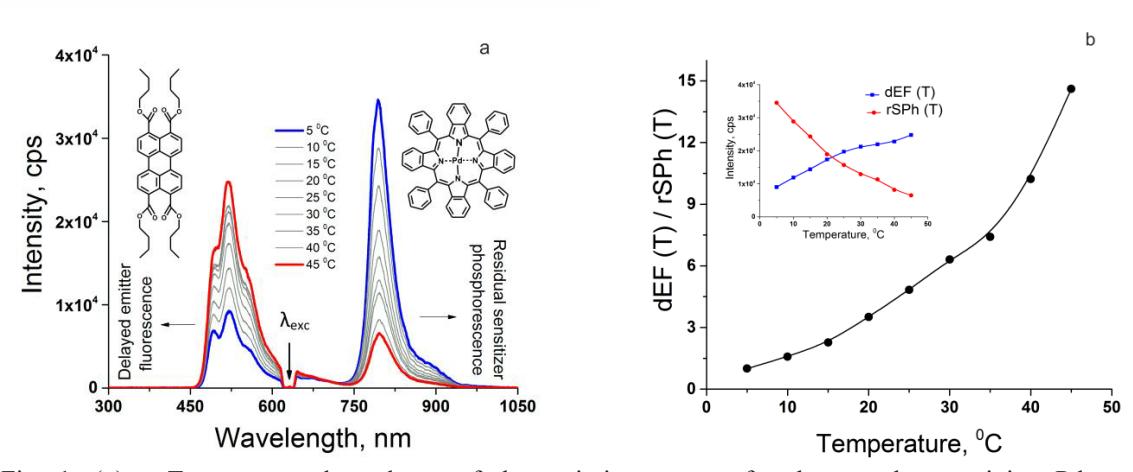
Main advantage of the demonstrated ratiometric-type temperature calibration is the independence of the data obtained on excitation intensity instabilities, local molecular concentration fluctuations and filed-of-view variations. All these advantages reveal the application potential of TTA-UC based temperature sensing tool in field of life-science