Fluorescent defects recently observed under ambient conditions in hexagonal boron nitride (h-BN) promise to open novel opportunities for the implementation of on-chip photonic devices that rely on identical photons from single emitters [1], [2], [3]. Despite a flurry of experimental results, the nature of these emitters remain unknown.
In this work we have performed density functional theory calculations of boron vacancies and boron vacancy complexes with oxygen in hexagonal boron nitride. Interaction with oxygen significantly lowers the formation energy of boron vacancies. Therefore, when oxygen is present, complexes are more likely to occur that bare vacancies.
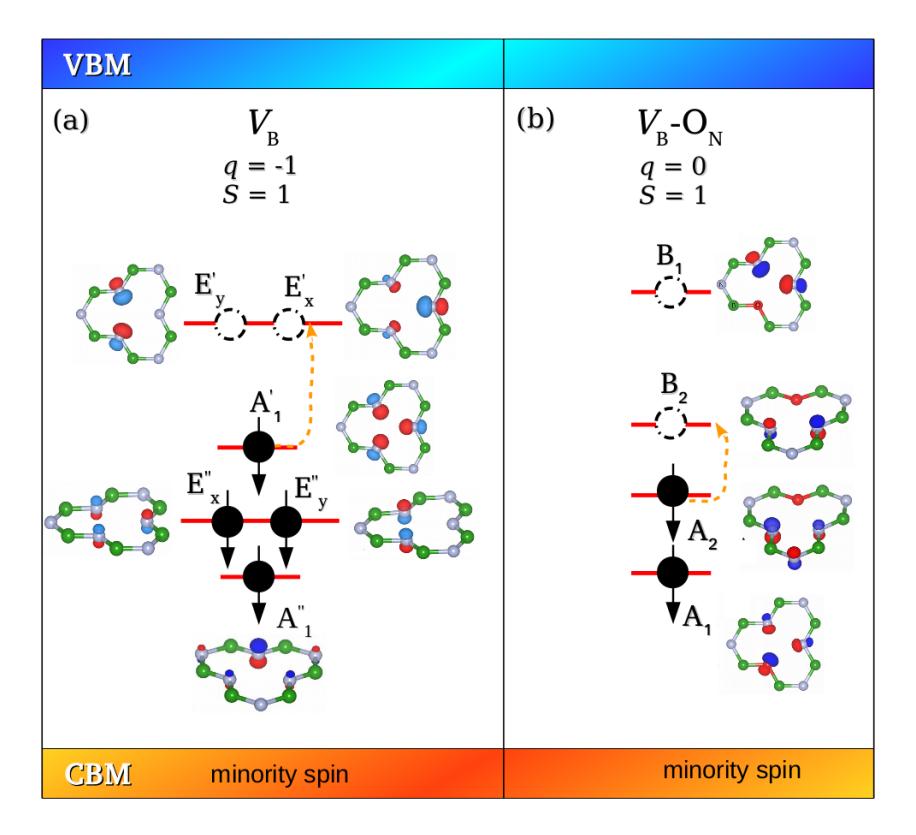
We find that electronic defect states can be of both $\sigma$ and $\pi$ type. This suggests that intra-defect luminescence can be polarized both in- and out-of-plane. A multitude of defects levels gives rise to various possible configurations of excited states. This provides a clue to the explanation why polarization of emission and absorption do not necessarily have the same orientation [4]. However, to induce a permanent dipole in bare boron vacancies local strain is needed. More specifically, in negatively charged boron vacancies the dominant transition is of the type $a_1' \rightarrow e'$. In unstrained h-BN the emission is unpolarized because transitions to either $e'_x$ or $e'_y$ are equally probable. These states are no longer be degenerate if some strain is present which sets a preferential direction in the xy plane. This reasoning is in good agreement with experimental results [4], where observed emitters were oriented in the same direction. We also provide estimates of intra-defect excitation energies and associated Franck Condon shifts, making the connection with recent experimental observations of single photon emitters in this material. These results are a significant step in identifying the structure and electronic states of defect-based single photon sources in h-BN.