Lanthanide-doped upconverting nanoparticles exhibit unique luminescent properties based on an upconversion process. Because of this process, upconverting nanoparticles have an ability to push infrared long-wavelength radiation into shorter visible wavelengths [1]. This anti-Stoke shift property is extremely useful in research of various biological tissues, because the majority of biological tissues exhibit absorption peaks in the ultraviolet region while the excitation radiation of lanthanide-doped upconverting nanoparticles is in the near infrared range[2]. This allows reducing the autofluorescence background and reaching more efficient penetration into biological tissue.
The aim of this research was to investigate the optical properties of NaGdF4: Er3+, Yb3+ upconverting nanoparticles and discuss how protein coatings could affect luminescence intensity in different media.
All of the measurements were performed with Edinburgh Instruments FL 920 spectrometer (Edinburgh Ins., UK) and for NaGdF4: Er3+, Yb3+ upconverting nanoparticles excitation, a MDL-III-980-2W laser (Changchun New Industries Optoelectronics Technology Co., China) with the wavelength of 980 nm and the excitation power of 1250 mW was used.
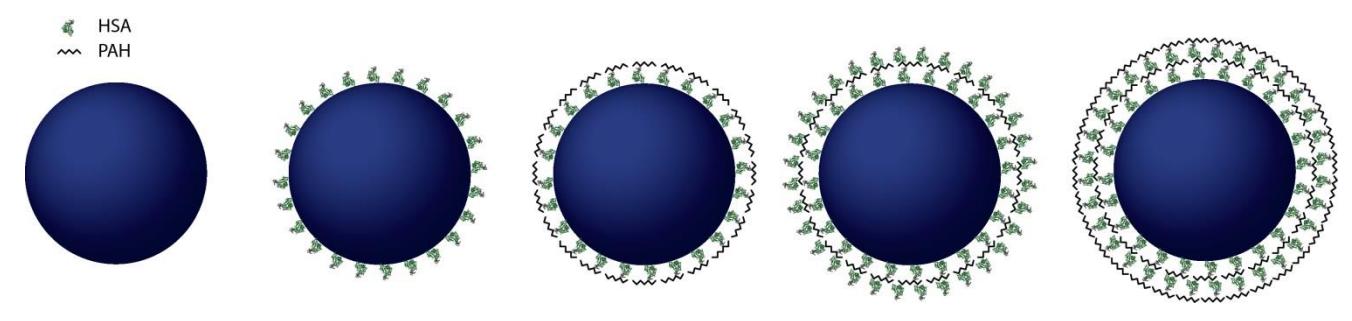
Investigation was executed in several stages. At first, five categories of NaGdF4: Er3+, Yb3+ upconverting nanoparticles with different surface coating were investigated to determine if human serum albumin (HSA) or polyallylamine hydrochloride (PAH) could have any effect on the luminescence intensity and stability of nanoparticles (Fig. 1). The reason why HSA was chosen is that in human blood nanoparticle is coated with naturally existing proteins forming a corona. This phenomenon usually leads to reduced stability of nanoparticle and artificial HSA coating could help to prevent this. The results of research showed that NaGdF4: Er3+, Yb3+ upconverting nanoparticles coated with one layer of HSA have the biggest luminescence intensity. This could be explained by the general increase of the nanoparticle's size. Finally, measurements with two different media – deionized water and Dulbecco's Modified Eagle's Medium (DMEM) – were made to reveal the change of NaGdF4: Er3+, Yb3+ upconverting nanoparticles stability depending on surrounding components. The results showed that NaGdF4: Er3+, Yb3+ upconverting nanoparticles in DMEM aggregated and lost the original optical properties while in deionized water stayed stable after more than 72 hours.