
Rapid production growth of solar cell and modules also increases a need of novel device characterization equipment. One of quality control stages in solar cell production is device testing under standardized irradiation conditions, provided by solar simulators. The most commonly used irradiance and spectral distributions aim to match so-called AM1.5G conditions [1]. IEC 60904-9 Ed.2.0[2] standard defines criteria of how A, B or C class can be assigned to solar simulator in three categories: spectral distribution match, temporal stability, irradiance distribution uniformity.Traditionally, Xenon arc lamps were the mostly used light source of solar simulators. However, they suffer from issues related to a relatively short lamp life and stability. Therefore, development of simulators based on light-emitting diodes, such as one reported in [3], are getting more and more attention due stability and long-time performance of light sources.
Results of simulation of solar simulator employing arrays of 5 different types of light emitting diodes and mirrors, as well as properties of the irradiance generated by a produced simulator, are covered in this paper. The influence on irradiance and spectral distributions at the measurement plane made by a system of mirrors was investigated. After that models for solar simulator were created using 19-25 LED's. According to this model, real simulator has been produced and the generated irradiance was compared to simulation results. Moreover, possibility of incorporation of light beam induced current (LBIC) measurement technique and possibility of making simulator for large area modules are investigated.
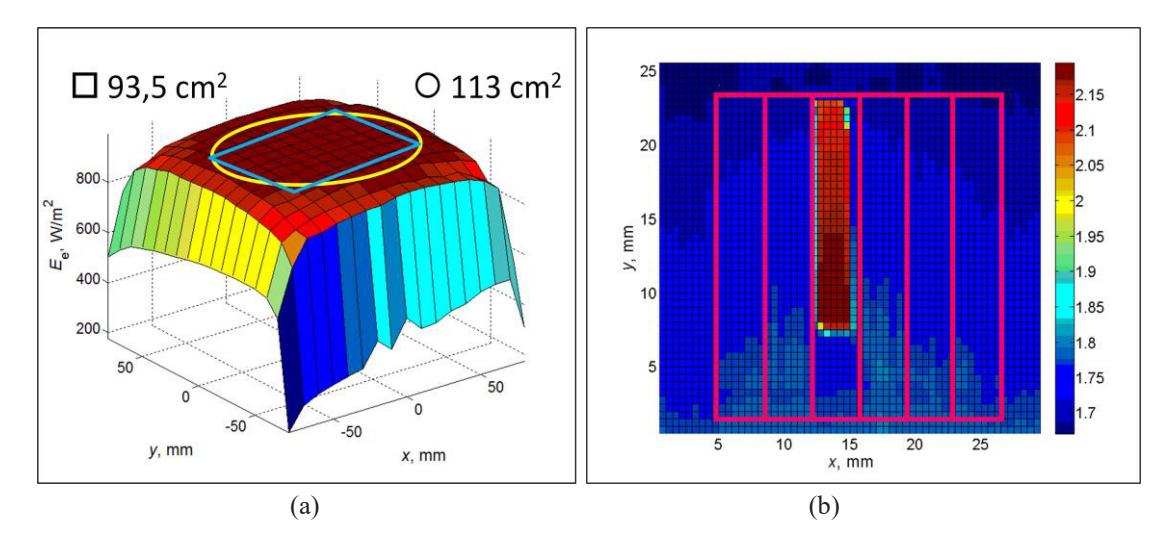
It has been demonstrated theoretically that there is possible to create AAA-class simulator for $(16 \times 16)$ cm2 area while using one Bridgelux BXRA series, 4 types of LedEngin LZ4 LEDs and a square system of mirrors. Real simulator provided A-class irradiance and B-class spectral distributions in $(8 \times 8)$ cm2 area. Replacing one big white LED with seven smaller ones lets us achieve AAA-class irradiance in 1,5 times greater area (93,5 cm2), as shown in Fig.1a. It has also been established that it is possible to incorporate LBIC method in order to reveal the current limiting cells of the solar panel (Fig. 1b). $9 \times 9$ matrix of imitator modules without mirrors could provide AAA-class irradiance in 1 m2 area from the height of 270 mm.