
The typical laser sources used for Optoacoustic (OA) imaging are solid state lasers, tunable dye lasers, and optical parametric amplifiers. These sources can provide pulses with energies in the range of mJ, with duration of several ns. However, their use for clinical application is limited by their low repetition rates, high cost and bulky size that is mainly due to the power supply and cooling requirement. On the other hand, the high power diode lasers (HPDLs) could be an alternative to overcome all the limitations of the conventional laser sources [1].
In this works we implement HPDLs system for OA applications. The system consists of 6 diode lasers of stacked layers out of which three are operating at 905 nm and other three operating at 870 nm. The output from these diode lasers coupled into optical fiber bundle with the help of collimating and focusing lens. The fiber bundle consists of 7 input fibers of 200 μm core diameter and output diameter of 675 μm. We characterised the output of fiber bundle by measuring the time synchronization between output pulses and they are perfectly overlapped in time [2].
The measurement setup consists of incoming light from fiber bundle, cuvette holder assembly with 90° provision for ultrasonic transducer, preamplifier, oscilloscope, and PC to record the OA signals. The output of the fiber bundle is collimated by a lens with 12 mm focal length to illuminates the sample uniformly. The beam diameter is 7 mm and the calculated fluence is 37μJ/cm2 for 905nm and 36 μJ/cm2. The OA signal was measured in orthogonal direction with respect to the input light using a 1 MHz ultrasonic transducer. In order to test the linear combination of the optical pulses, we characterized the system by measuring the OA signal generated from 1% concentration of ink solution hosted in a 1 cm quartz cuvette.
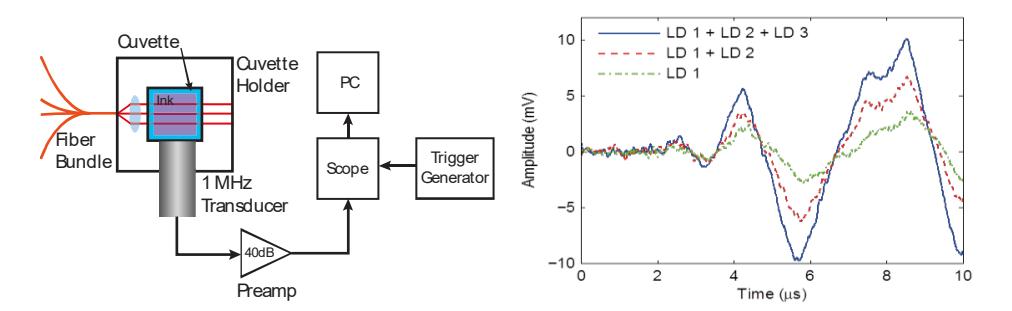
We have implemented a HPDLs based opto-acoustic system by combining power using optical fiber bundle from several diode lasers. In the OA detection scheme, we used a 90° measurement setup to detect OA signals from 1% ink solution. This 90 degree measurement scheme helps to reduce the signal generating on the surface of the detector in the case of transparent solution. This system can be further be scaled for multiwavelength applications.