Ultra-short laser pulse interaction with matter is a fascinating field that has attracted a lot of attention over the recent years [1]. High peak power, ultra-short electromagnetic pulses interact with matter in a non-linear way, thus creating potential for advanced micro-machining technologies to emerge. A lot of effort has recently been given for investigation of femtosecond laser induced modifications in transparent materials [2, 3]. It relies on non-equilibrium process with photon beams and this provides new access to create materials and micro-devices that cannot be obtained by other means [4]. One of the approaches for such fabrication is femtosecond laser induced chemical etching (FLICE).
Using this technique, a tightly focused femtosecond laser beam is scanned inside a transparent material, drawing an arbitrary shape. Due to non-linear interaction, part of the light is absorbed. This alteration of the material changes its etching selectivity – laser illuminated silicon rich areas become soluble in KOH or HF. By providing proper windows for the etchant to reach laser-exposed parts within the bulk of the material, any arbitrary 3D shape can be fabricated inside a transparent material. However, there are plenty of laser writing parameters to consider when searching for optimal fabrication speed, as both laser writing and subsequent etching are rather time consuming processes. This research is dedicated to figure out the dependencies of pulse density, scanning speed and pulse energy on the etching rate in KOH.
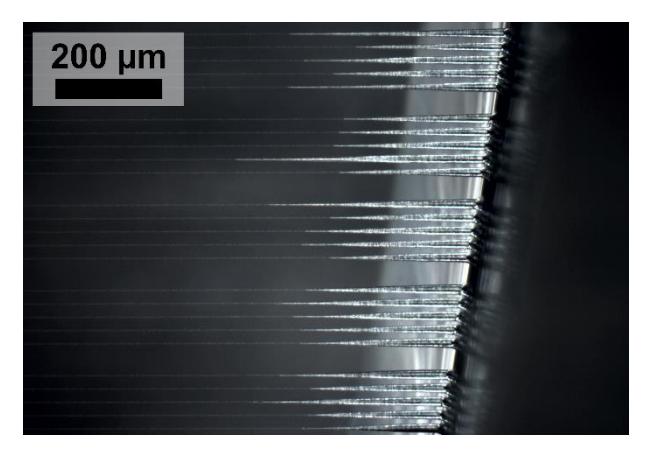
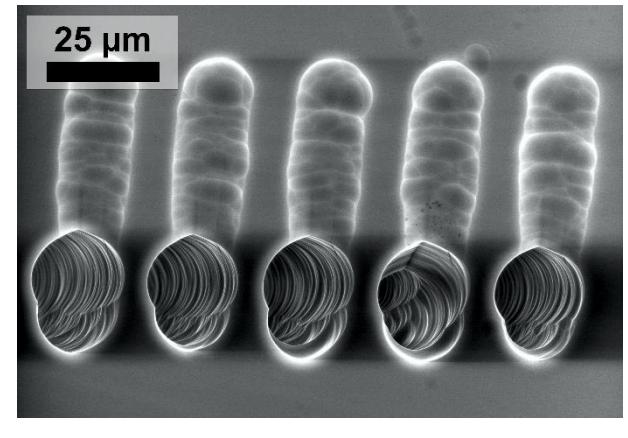
As described in literature [4], three types of transparent material alterations are possible – a slight refractive index change when the pulse energy is below the necessary threshold, formation of nanostructures when it is above the threshold and finally void formation when the pulse energy is exceedingly large. The second type modifications demonstrate reasonable etch selectivity. Fig. 1 and 2 depict channels in fused silica etched by KOH after a single-pass scan of individual lines using a second harmonic of Yb:KGW femtosecond laser PHAROS (Light Conversion) and XYZ sample translation performed with laser microfabrication setup FemtoLAB (Altechna R&D). Thus achieved validation of FLICE technique will enable to further investigate non-linear processes of light-matter interaction and develop an advanced technology for realization of novel 3D microfluidic channels towards lab-on-a-chip devices.