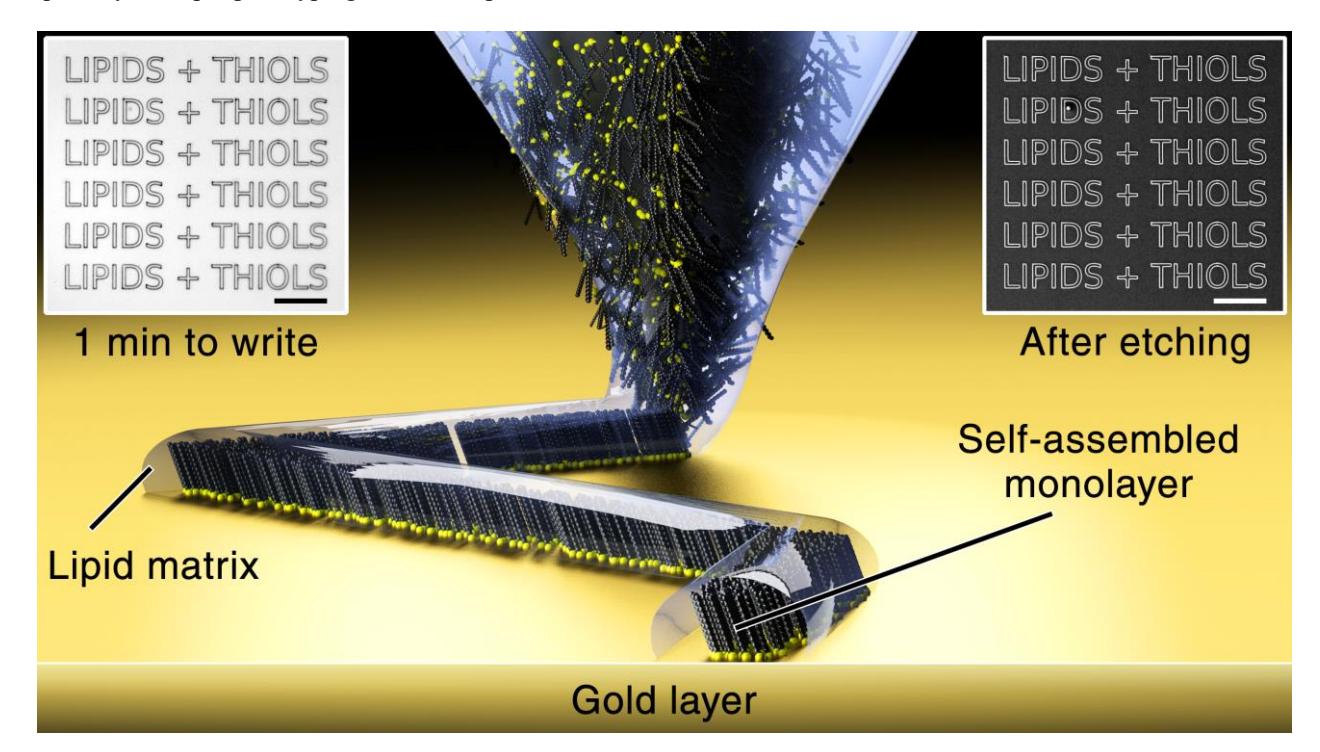
Dip-pen nanolithography (DPN) is a scanning probe-based fabrication technique that allows direct writing/arraying of different molecules including lipids [1]. It is useful for nanoscale chemistry studies as well as for rapid prototyping of micro/nano devices. Despite numerous previous studies on a variety of bifunctional reactive compounds (DPN inks), the method is limited by the rather slow transport from the scanning probe onto the substrate. To address the problem of the low process efficiency, we have explored the molecular ink (eicosanethiol – ECT) transport in a liquid-like carrying medium (dioleoyl-phosphatidylcholine – DOPC lipid). Our aim was to increase the surface patterning speed for nanofabrication of metal nanostructures.
First, we have characterized the diffusion behavior of the ECT ink. Also, we studied molecular deposits on Au surfaces formed of pure DOPC and DOPC/ECT mixtures, respectively, by using imaging ellipsometry. As expected, the pure DOPC carrying medium was completely removed by treatment in chloroform, whereas the ECT-containing mixed inks yielded self-assembled monolayers (SAMs) of different quality, depending on the patterning speeds. Upon employing the ECT SAMs as resists for wet chemical etching of Au in aqueous etchant solutions, they acted as a sufficient barrier for etching. A more detailed ink transfer analysis indicated, that the DOPC carrying medium enabled us to boost up the DPN patterning speeds up to 30 times as compared to the pure ECT thiol. Moreover, the molecular writing in the carrying medium allowed us to increase the overall writing capacity up to 50 times and to obtain cm-sized patterned surface areas while using a single regular scanning probe inked only once. Finally, to demonstrate the applicability of this technique, we fabricated single cell electrode arrays and metamaterial-like structures, similar to the previously reported arrays that displayed strong second harmonic generation [2].
To summarize, we have characterized for the first time the molecular transport of chemically reactive compounds in lipid medium. We have shown that for the low molecular weight alkylthiol inks this process is governed by the highly efficient lipid transfer allowing to reach DPN patterning speeds up to 100 μm s-1. The high versatility of this desktop fabrication technique makes it a competitive alternative to more expensive and complex electron beam lithography, especially for rapid prototyping of mesoscopic metal structures.