The Bi-Sn system is the promising basic compound for thermoelectrical p-type materials at low and medium temperatures [1].
The presence of several types of charge carriers (light electrons, light and heavy holes) encourages the researchers for the search of suitable galvanomagnetic methods for electronic properties characterization. Standard formulas for magnetoresistance and Hall coefficient are not applicable, so we propose the approach based on Fourier Mobility Spectrum Analysis (FMSA) technique.
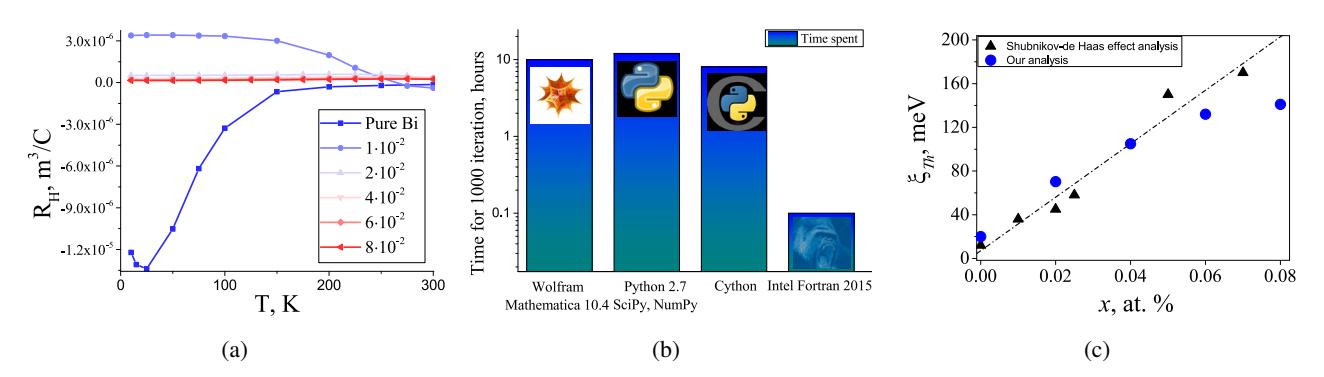
We choose doping level of Bix-Sn1-x small enough ($x \le 0.08$ at. %) to keep dispersion law and electronic bands shape of Bi unchanged. The rapid solidification method allows the cheap synthesis of uniform polycrystalline samples (30 μm thickness, less than 1% surface roughness). We measured magnetoresistance and Hall coefficient (see Fig.1(a)) in temperature range 4−300 K under magnetic fields up to 8 T. Then, we determined magnetoconductivity tensor components from galvanomagnetic data for usage as the input to the FMSA code.
The FMSA code was implemented with Fourier-space fitting algorithm in addition to standard iterative fitting in direct-space and including derivatives to mean squared error [2]. Several versions of the code were made in different languages. The Fortran version of code proved itself to be the fastest, Fig.1(b).
The concentrations, mobilities and Fermi level temperature dependences were estimated for the studied range of Bi doped with Sn for the first time. For the He temperatures the comparison between our result and Fermi level found from the Shubnikov-de Haas oscillations [3] showed good coincidence (see Fig.1(c)).
The presented technique allowed us to extract not only low-temperature position of Fermi level but all the temperature range dependence of Fermi level. It was found that temperature dependences do not match with the Sommerfeld expansion due to significant relative changes in Fermi level values with temperature.