THz radiation, have many positive aspects such as non-ionizing radiation characteristics which means it is no harm to people, moreover it has the ability to pass through non-metallic minerals and dry substances. Therefore, there are many potential applications for this range of frequencies . However, existing sources of THz radiation have low power. Therefore, there is room for improvement in signal detection to obtain the best signal-to noise ratio possible.
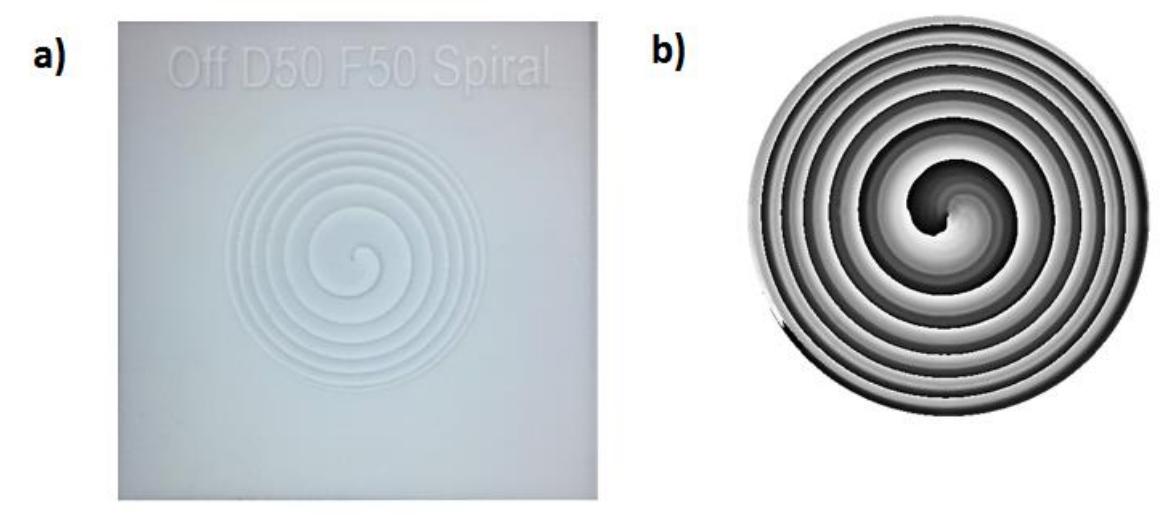
It is not determined which part of the detector collect most of the incident light. The aim of this study is to test whether the pyroelectric antenna detects better illuminated by radiation in shape of the ring. To focus light into ring spiral lenses was modeled and 3D-printed.
The modeling of the optical element was carried out on arrays 4096 x 4096 pixels with the sampling 117 μm x 117 μm. It was designed for the frequency of 300 GHz (DWL 1 mm). Optical element was a spiral structure of dimeter 50 mm and focal length 50 mm.