
Knowledge of the full potential energy or at least its part is a key element of different fields – molecular dynamics, vibrational and UV spectroscopy, photoexcitation and etc. It is well known one of the ways to determine the PES is to use ab-initio calculations. If during vibrations atoms dispacements from their equilibrium positions are insignificant, then one can use harmonic approximation for calculations of the potential energy surface. However, vibrations of the small atoms, especially the ones that involve hydrogen atom, are anharmonic vibrations due to large amplitudes of the atoms motions. Analysis of the calculated PESs can provide scientists with valuable data on the properties of the investigated molecules. This data can be especially valuable in case of large amplitude motions.
Here we propose a new way of evaluation of the PES anharmonicity degree. Our method is based on the quantitative expression of the differences between the harmonic and calculated PESs. We detmine the degree of anharmonicity for 1D and 2D PESS as follow:
$$\eta = \frac{1}{N} \sum_{i=1}^{N} \frac{\left| U(x_i) - U^h(x_i) \right|}{U^h(x_i)} \qquad U^h(x) = \frac{f_{xx}x^2}{2} \qquad f_{xx} = \frac{d^2 U(x)}{dx^2} \Big|_{x=0}; \dots \tag{1}$$$$\eta = \frac{1}{N} \sum_{i,j=1}^{N_i, N_j} \frac{\left| U(x_i, y_j) - U^h(x_i, y_j) \right|}{U^h(x_i, y_j)} \qquad U^h(x, y) = \frac{f_{xx} x^2}{2} + \frac{f_{yy} y^2}{2} + f_{xy} xy \qquad f_{xy} = \frac{d^2 U(x, y)}{dx \cdot dy} \Big|_{x=0, y=0} \tag{2}$$where x,y - natural vibrational coordinates, characterizing variations in the length of a hydroxyl group, $U(x_i, y_i)$ – potential energy, calculated at point $(x_i, y_i)$, $U^h(x_i, y_i)$ – potential energy, calculated at point $(x_i, y_i)$ in harmonic approximation.
Values of the parameter $\eta$ were calculated for O-H group of the number of molecules and complexes with different type of the hydrogen bond: methanol dimer, malonaldehyde, formic acid dimer, pyridine N-oxide and trichloroacetic acid free complex and comples in acetonitrile, protonated water dimer. Calculations were performed using different number of points N and different ranges where x and y coordinates are varying. In case of 2D PESs two methods of the anharmonicity degree calculations were implemented. The first one is similar to the case of 1D potential curves, where $\eta$ was calculated as difference between harmonic and calculated PESs in a number of points along two axis. The second method was implied in order to perform more uniform investigations of 2D PESs. For this method harmonic and calculated PESs were intersected by a cylinder (see Fig. 1) and differences between harmonic and calculated energy values were calculated at points of the cylinder intersections of two surfaces.
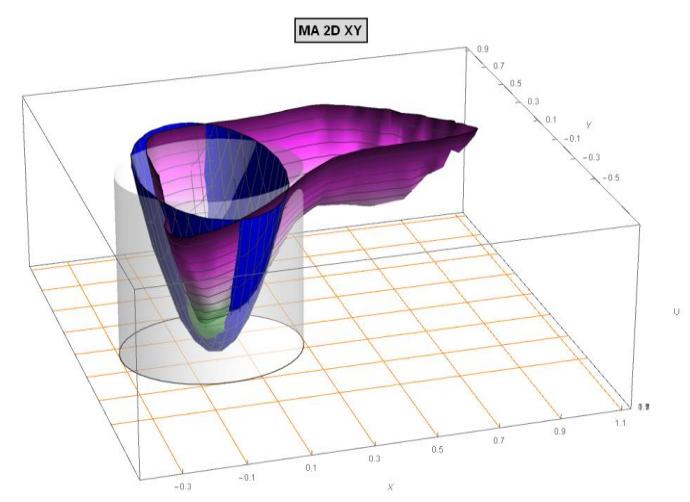
While analyzing PES anharmonicity it can be noted that from phsical point of view with the right choise of vibrational coordinates there should be one coordinate, which can be characterized by the maximal deviation of the calculated PES from the harmonic one. We performed calculations that allowed to analyze which linear combination of the vibrational coordinates allows to characterize the PES more percisely in terms of anharmonicity. To permorn such calculations we constructed the section planes for PESs with the step equals to 5° and then analyzed obtained 1D curves to indicate the directiction where calculated and harmonic energy values have the greatest difference.