Light upconversion via sensitized triplet-triplet annihilation allows to upconvert polychromatic light even at relatively low excitation power densities [1]. This feature is very attractive for solar energy harvesting, as the radiation power is sufficient for the process to take place. However, for the practical applications the efficiency of upconverting polymer films is still too low due to several factors. One of the main factors is aggregation of the emitter in polymer matrix and aggregation-induced emission quenching [2]. To this end, chemical modification of anthracene compounds to reduce emitter self-quenching and achieve high upconversion efficiency was attempted.
For this study, upconverting films based on sensitized platinum-octaethylporphyrin (PtOEP) and modified anthracene compounds in poly(vinyl butyral-co-vinyl alcohol-co-vinyl acetate) (PVBVAVAc) polymer were fabricated by melt processing technique. The concentration of anthracene compounds in the polymer matrix was chosen to vary from 15 wt% to 50 wt%. The PtOEP/anthracene compound/PVBVAVAc films were evaluated by measuring fluorescence, phosphorescence and upconversion spectra as well as estimating their emission quantum yields.
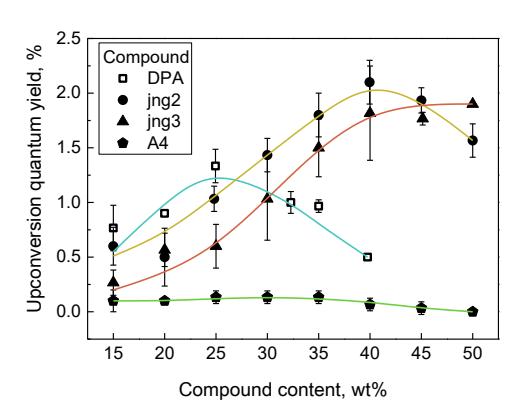
The obtained data showed that complementary alkyl groups in anthracene compounds (jng2 and jng3) significantly reduce self-quenching effects and enable fabrication of upconverting films with high emitter concentrations, up to 50 wt%. High emitter concentration facilitates triplet exciton migration essential for achieving high upconversion quantum yield in polymer films (Fig. 1). The maximal upconversion quantum yield of 2.1% was attained in PtOEP/jng2/PVBVAVAc film at 40 wt% of jng2. Upconversion quantum yield of PtOEP/jng3/PVBVAVAc film was found to persistently increase with jng3 concentration reaching its highest value (1.9%) at 50 wt%.