
Computer models for describing the spatial stress-strain state of a system automobile tire-asphalt are of great practical importance for road transport. Also important challenge for manufacturers of tires and road services is the assessment of volume damageability and wear of the tire tread and the asphalt pavement, which work in conditions of contact, mechanical and sliding fatigue. Today, there are many works dedicated to analytical and computer simulation of stress-strain state of the "rim-tire-asphalt" system components [1,2]. However, the problem of estimating the simultaneous contact interactions of system elements, their 3D stress-strain state and the state of the volumetric damageability is still not fully investigated.
The main goal of this work is to use finite-element modeling for the analysis of simultaneous contact interactions of the multielement system "rim-tire-asphalt", loaded by the inner pressure (850 kPa) and radial load (2500 N) on rim, 3D stress-strain state and the state of volumetric damageability.
Truck tire geometric model of 22.5" radius with a simplified rim was taken for the calculation in ANSYS [3]. The following components were added to the model of tire (Fig. 1-b): layers of steel belt, radial ply, wire bead, rubber tread.
Calculation of damageability is based on the model of deformable solid mechanics with dangerous volume. According to this model dangerous volume is the volume where acting stresses are greater than limiting stress [4].
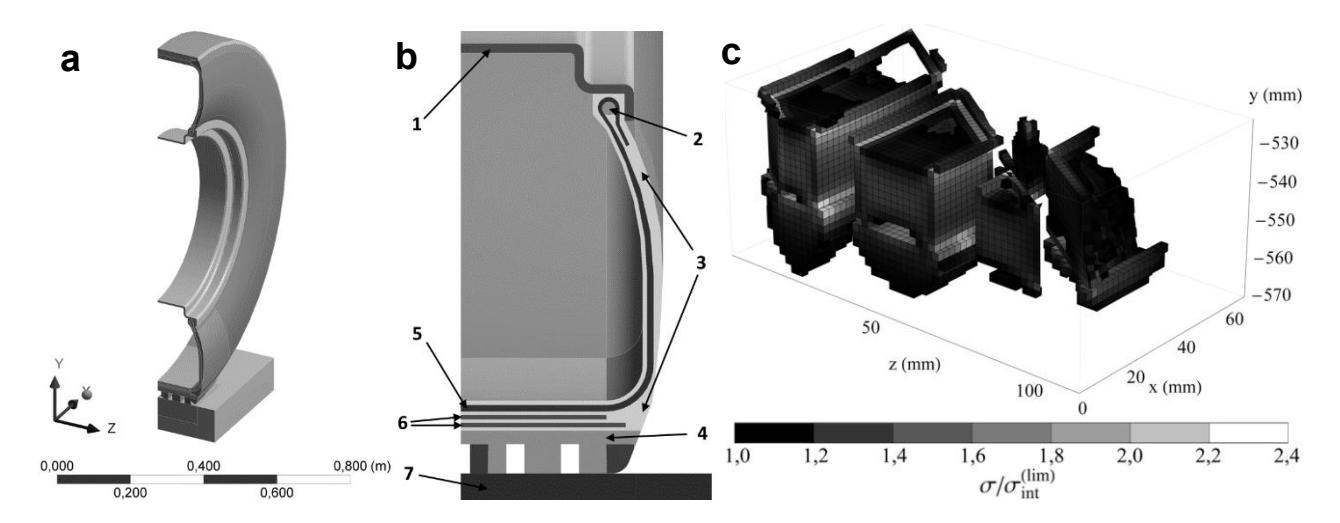
In this work the computer simulation of stress-strain state of the "rim-tire-asphalt" system for the action of inflation air pressure in the tire and weight on the rim was made.
Distributions of stresses in the system are obtained. In these distributions we considered contact interaction between tire and asphalt-concrete pavement. Maximum of contact pressure is 3.4 MPa. Stresses in rubber are about 1.5 orders less than in other system elements, but strains are higher, because other system elements are harder.
Volume damageability of tire and asphalt in the contact zone were calculated. Obtained dangerous volume (Fig. 1-c) in the tread are 2-2.5 times higher than in the pavement (Table 1), because asphalt is harder. Dangerous volume based on stress intensity in rubber and asphalt is twice greater then dangerous volume based on minimum principal stress.
| Vint, mm3 | Ψint, mm3 | V3, mm3 | Ψ3, mm3 | |
|---|---|---|---|---|
| Tire | 168 238,4 | 221 018,0 | 322 635,2 | 477 016,0 |
| Asphalt | 77 540,8 | 91 878,4 | 139 151,6 | 170 961,6 |