In this work, synthesis, nanocrystallization and characterization of glassy lithium manganese borate with nominal formula LiMnBO3 were described. The reason for interest in this compound and taking it into account as a potential cathode material for Li-ion batteries is its high theoretical gravimetric capacity reaching 222 mAhg-1 [1].
LiMnBO3 was synthesized using melt-quenching method from substrates: Li2CO3, Mn(CH3COO)2 . 4H2O and H3BO3. This way, three samples with different parameters (maximum melting temperature and time) were obtained. Parameters of the batches and their naming are as follows: 20 min, 1015 °C – G02a; 25 min, 1035 °C – G02b; 30 min, 1070 °C – G02c.
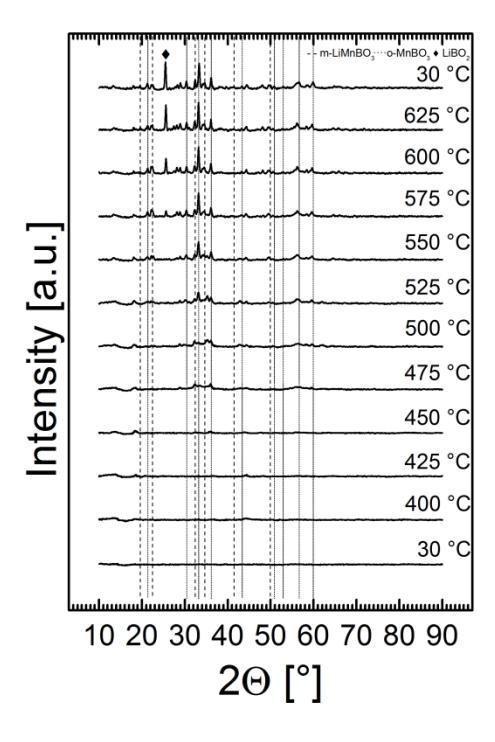
Material was investigated with differential thermal analysis (DTA) and X-ray diffractometry (XRD) methods. Results obtained with differential thermal analysis, carried out within 25-650 °C range, proved that typical processes for glassy materials (glass transition and crystallization) appeared in all three samples. In Fig. 1, one can see that increase of temperature leads to increase of peaks intensity meaning that crystallization process in the sample occurs. Cooling down to the room temperature caused only minor changes. X-ray diffractometry measurement confirmed lack of crystalline phases at room temperature, which is typical for amorphous materials. Samples were amorphous till 400 °C, and above that temperature, first visible peaks characteristic for different compounds appeared. For all of the diffractograms for a given sample, the background was substracted and the data was normalized to the highest intensity in each graph, respectively. It was due to observe the relative changes between diffractograms in different temperatures. Diffractograms for different parameters of synthesis of the samples vary – different phases are observed after nanocrystallization. The most preferable phases (orthorhombic MnBO3 marked as o-MnBO3, and monoclinic LiMnBO3 marked as m-LiMnBO3) were indicated with dashed and dotted lines; other, less significant phases were marked with various symbols. Grain sizes were estimated in the range from 30 nm to 150 nm, changing for different synthesis parameters and phases.