
Organic optoelectronics is one of the most rapidly growing fields of research due to its potential applications in organic light emitting diodes (OLED), organic solar cells, sensors etc. Majority of OLED devices are based on thin organic films fabricated by thermal evaporation in high vacuum. Thermal evaporation enables formation of multi-layered structures composed of charge transport or carrier blocking films and generally ensures high performance of the devices. However, this technology is only suitable for mass production of small- and middle-sized OLED displays. In this case solution processing of multi-layered organic films could benefit in low-cost and large-area devices.
The main goal of the present work was to get acquainted with blade-coating technique used for solution processing of organic films. The technique is advantageous since it can be employed for fabrication of OLEDs on an industrial scale [1]. During this research, functional organic films were processed from two organic polymers: poly(3,4-ethylenedioxythiophene)-poly(styrenesulfonate) (PEDOT:PSS) and poly(9-vinylcarbazole) (PVK), which are typically used for hole injection and transport, respectively. Blade-coating parameters such as the coating speed, the concentration of solution, the space between blade and substrate as well as other external factors (e.g. hot air flow) have been varied to investigate their influence on layer thickness (h) and surface roughness (Rq). Atomic force microscopy (AFM) was employed to estimate these films properties.
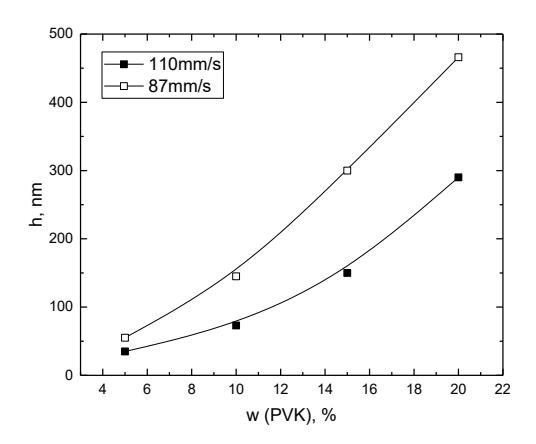
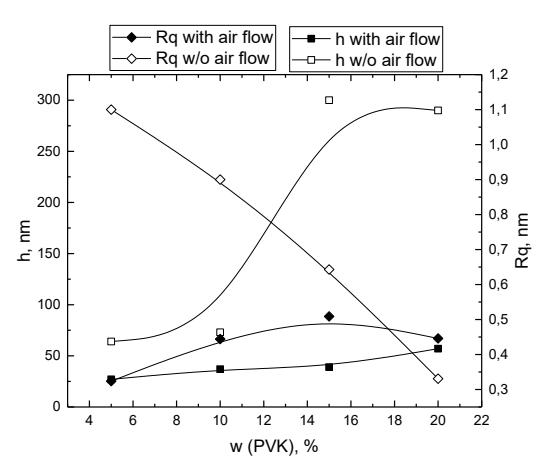
The preliminary results indicated that the quality (smoothness) of blade-coated films can be improved by utilizing faster coating speeds and by applying hot air flow.