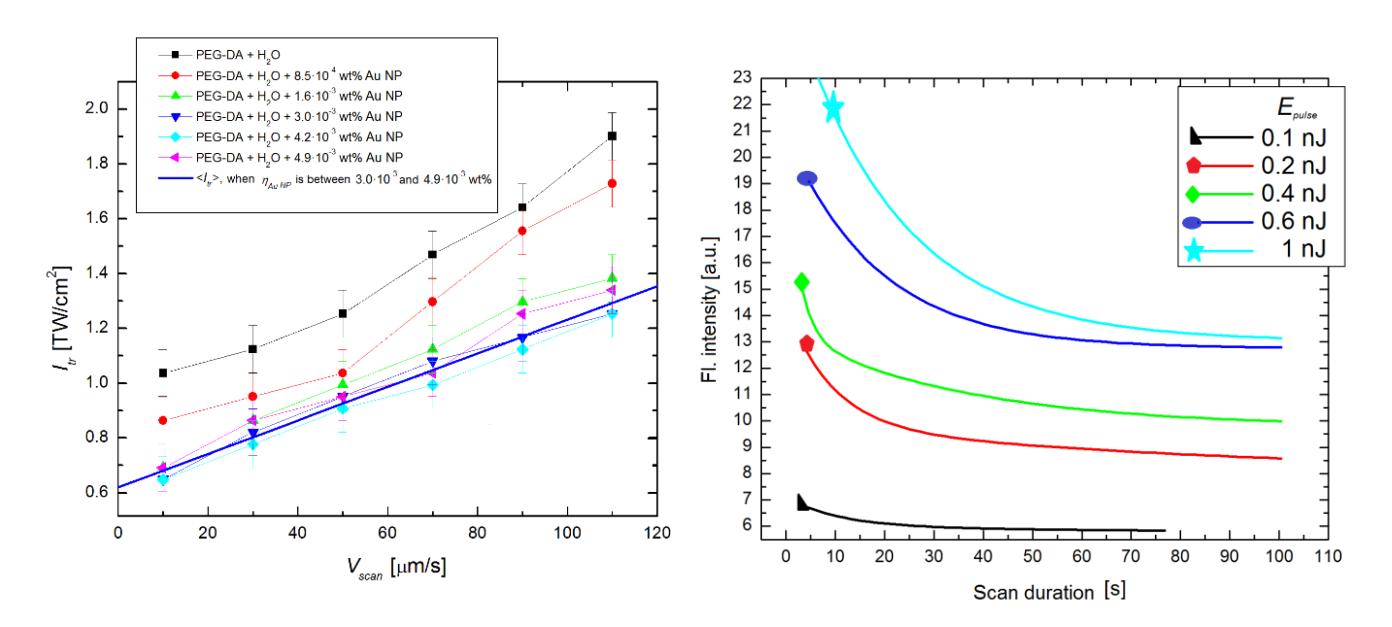
In recent years, three-dimensional direct laser writing (DLW) technique has made impressive progress regarding both resolution and feature size of the written structures. However cytotoxicity of virtually all commercially available photoinitiators [1] prevents DLW formed 3D microstructures from wide application in such emerging bio-medical applications as manufacturing of drug delivery agents or bio-compatible, bio-degradable implants. Also, there are only few experimental attempts to evaluate local temperature changes when polymerization reaction takes place during direct laser writing (DLW) process. Furthermore, those few experimental works concludes to completely contrary results even when employing similar experimental set-ups and materials [2, 3].
In this work we investigate the influence of gold nanoparticles (Au NP) (as potentially bio-compatible photoinitiator) to photosensitivity of PEG-DA-700 photopolymer and test bovine serum albumin stabilized Au (BSA-Au) nanoclusters as thermosensitive agent for in-situ temperature change detection during the polymerization reaction in DLW process. Our research shows that doping PEG-DA-700 monomer with Au NP (doping concentrations varying between $3 \cdot 10^3$ and $4.8 \cdot 10^3$ wt%), plasmonically enhances photopolymer sensitivity as measured polymerization threshold values was 25 - 35% lower compared to pure PEG-DA monomers mixture (Fig. 1). We also showed that detection of fluorescent response from PEG-DA photopolymer, doped with BSA-Au nanoclusters, enables to indicate relative temperature gradients during DLW process (Fig. 2) and to prove the thermo-accumulation phenomena when employing $\tau < 300$ fs pulses for polymerization reaction initiation.