
Interference lithography is a technique for patterning regular arrays of fine features, without the use of complex optical systems or photomasks. It is a very efficient method to make array of periodic microstructures used in tissue engineering, microoptics, microfluidics and photonics. An interference pattern between two or more coherent light waves is set up and recorded in a photosenstive polymer. Light induced photopolymerization reaction starts when photoinitiator molecule absorbs photon and splits into active radicals [1]. There was examined that density of active radicals using different laser pulse durations and pulse repetition rates define geometrical properties of microstrutures. In order to compare microstructures formed by using different laser pulse durations and repetition rates pulse peak intensities were kept comparable for both nano and picosecond pulses.
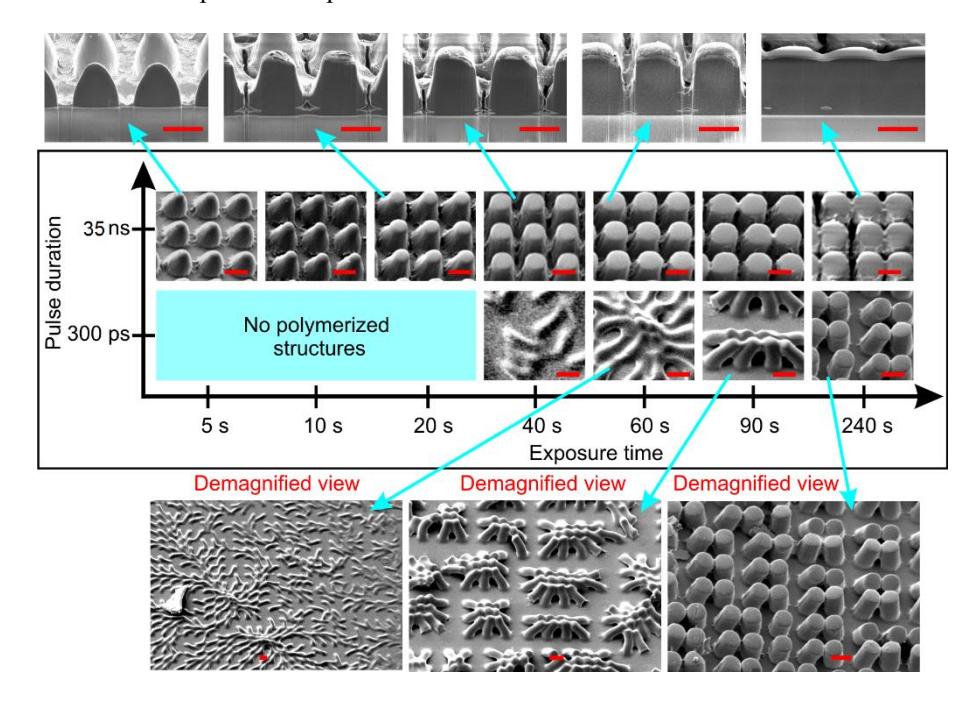
Radical density generated during laser irradiation (35 ns and 300 ps) is one of the main reasons that leads to geometric differences of the pillars formed in the photopolymer. Also it was demonstrated that using different repetition rates of the same laser pulse different polymerization reaction kinetics and different size microstructures can be achieved [2].