There is a need in the industry and many applications for beams with long focal lines and small focal spot sizes (so-called "Optical needles" [1]). Nondifracting Bessel beam is a common example of the simplest optical needle and a coherent superposition of Bessel beams can be used to create further optical needles, especially, if the control of the longitudinal distribution of the electric field is desired. However, a controllably asymmetric profile of the beam cross-section is of particular interest for some applications, including laser micromachining of structures with dimensions comparable to the wavelength of incident light.
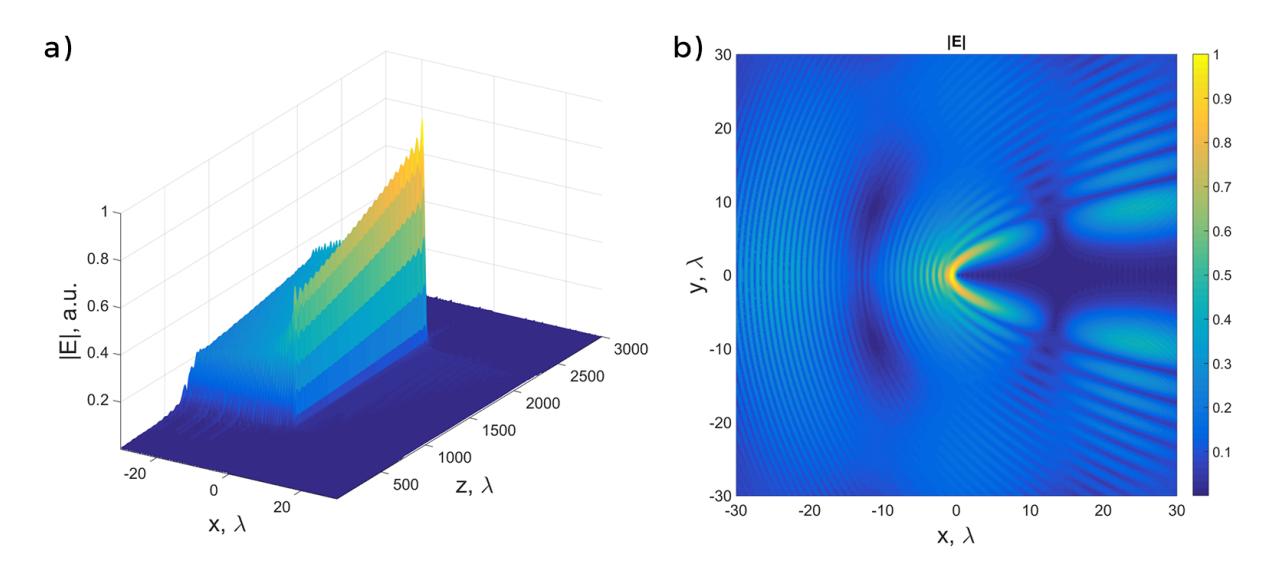
Using superpositions of nondiffracting parabolic beams we can control their longitudinal profile (Fig. 1a) and parabolically shape transverse distribution profile [2] (Fig. 1b). Because of distinct parabolically shaped cross-section this type of beam profile can be perceived as an "optical shovel".
Classical vectorization method described in [3] (${\boldsymbol{M}} = \nabla \times {\boldsymbol{a}} \psi$, ${\boldsymbol{N}} = \frac{1}{k}\nabla \times {\boldsymbol{M}}$; where ${\boldsymbol{a}}$ is Cartesian unit vector, $k$ is wave vector and $\psi$ - scalar parabolic solution) is used to obtain vector solutions, because scalar solutions become not valid when the beam is focused with lens of high numerical aperture and polarization control is needed.
A method of optical engineering of a focal line with controllable longitudinal profile, parabolically shaped cross-section and orientation of electric field will be presented. An optical shovel created by superposition of 101 monochromatic vector parabolic beams is demonstrated - the longitudinal distribution profile on axis and the transverse distribution profile (bending) can be varied independently.