Supercontinuum generation is a widely studied topic in nonlinear optics as broadband, high brightness and spatially coherent supercontinuum sources found applications in various fields such as spectroscopy, optical coherence tomography, biomedical optics, etc. [1-2] Photonic crystal fibers (PCF) are an attractive nonlinear medium for supercontinuum generation due to ability to engineer the photonic crystal fiber's dispersion, high nonlinearity and unique waveguide properties [3]. The physics of supercontinuum generation has been investigated and discussed in many research papers, however, there are certain experimental parameters whose influence to supercontinuum generation has not been investigated experimentally. One of such parameters is chirp of pump pulses.
In this study we present experimental results of our investigation of supercontinuum generation in photonic crystal fiber using chirped femtosecond pulses. The pump source was Yb:KGW laser oscillator generating 52 nJ energy 110 fs duration bandwidth limited pulses at 1030 nm with 76 MHz repetition rate. The nonlinear medium was a 32 cm long polarization maintaining photonic crystal fiber with zero dispersion wavelength at 800 nm manufactured by NKT Photonics A/S. Pump pulses were chirped by allowing them to propagate back and forth through a pair of SF11 dispersive prisms. The amount of chirp was changed by changing the distance between dispersive prisms and the optical path length of the beam in the prisms.
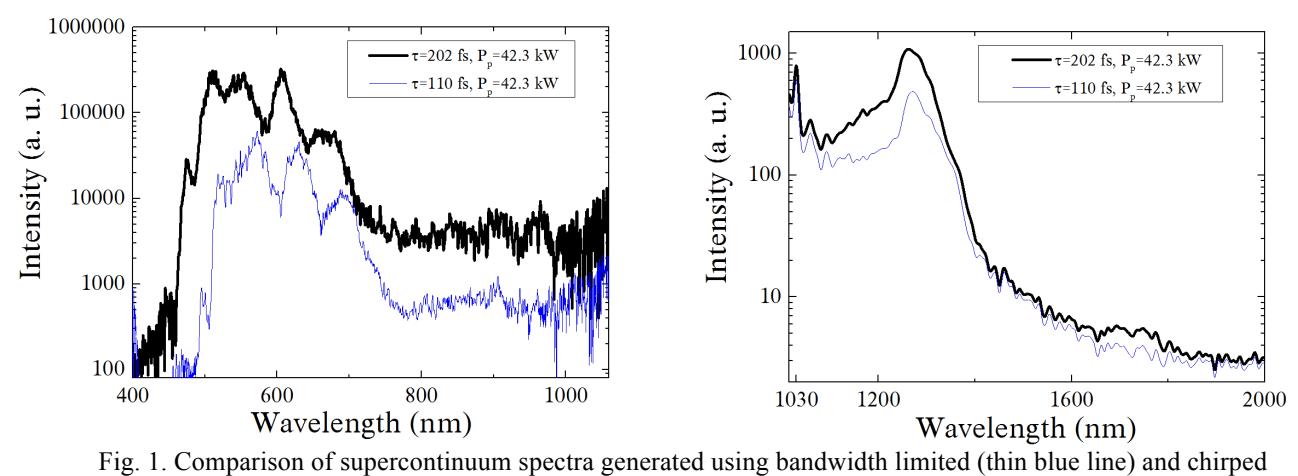
Supercontinuum generation is a result of many interacting nonlinear phenomena. To investigate the complex nature of supercontinuum formation process, we firstly measured supercontinuum spectrum dependence on pump pulse energy. In case of bandwidth limited pulses at maximum pulse energy supercontinuum spectrum extended from roughly 420 nm to 1500 nm. Further on, we compared supercontinuum spectra generated using bandwidth limited pump pulses (generated by our laser) and supercontinuum spectra generated using chirped pulses. The comparison must be done at the same peak power level as in our case it means the same peak intensity which is the key parameter determining the strength of nonlinear phenomena and their interactions. The results show that at the same peak power supercontinuum spectra obtained using chirped femtosecond pump pulses are broader than the ones obtained using bandwidth limited femtosecond pump pulses (Fig. 1). Left picture in Fig. 1 depicts spectra measured using spectrometer with VIS and part NIR range sensitivity, right picture – spectra measured using spectrometer with NIR range sensitivity. The additional broadening (compared to supercontinuum spectra in case of bandwidth limited pump pulses at the same peak power) depends on the amount of chirp. Under our experimental conditions it varied from several tens of nanometers at chirp values close to zero to more than 100 nm at highest chirp values we could achieve under our experimental conditions (+10600 fs2). Moreover, the difference between supercontinuum spectrum short-wavelength limits is greater than difference between long-wavelength limits. We believe that chirping pump pulses changes the strength of certain nonlinear phenomena which participate in supercontinuum formation process causing additional spectrum broadening.