
The Belarusian Satellite (BS) was launched into orbit by «Sojuz-FG» launch vehicle from the «Baikonur» Cosmodrome in Kazakhstan on July 22, 2012. The BS has a Panchromatic Imaging System (PIS) that allows to capture black and white images with a ground resolution of 2.1 meters and a Multispectral Imaging System (MIS) to capture images with a resolution of 10.5 meters using four spectral bands [1].
There is an opportunity of combining the panchromatic band with high spatial resolution and low spatial resolution bands of the BS multispectral image for obtaining high spatial resolution color images. To tackle this task it is necessary to solve a number of such subtasks as spatial combination and alignment of images, interpolation of the multispectral image bands up to the panchromatic image resolution, a pansharpening and obtaining the RGB image. At the same time the solution has to be universal and suit not only BS multispectral images, but also any other both multispectral, and hyperspectral images. All subtasks can be understood, when looking at figure 1. Here area 1 is the panchromatic image, area 2 is any band of the multispectral image; N1 (black) is nodes and a net of multispectral image band, N2 (grey) is nodes and a net of panchromatic image.
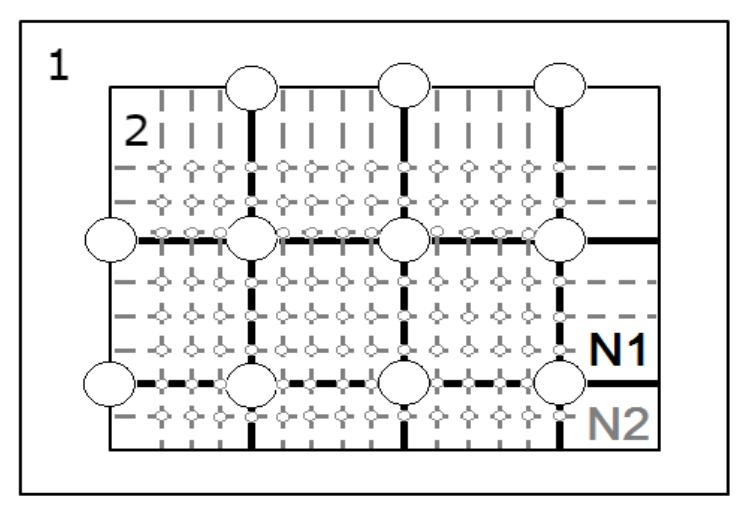
Spatial combination of images (in fig. 1 is alignment of area 2 to area 1) can be reached by means of various algorithms. One way is to use preliminary interpolation of the multispectral image band with the subsequent binarization (using Otsu's method [2]) and segmentation. The next step on this way is to find area in previously binarized panchromatic image with the largest similarity to previously chosen segment using cross-correlation algorithm [3]. Another way is to find the same reference points on both images. Such reference points also can be found with using binarization and further segmentation techniques.
After combination of images, we have to interpolate a multispectral image band up to panchromatic image using imposing the interpolation grid (N2 onto N1). The nodes here are pixels in common sense. It is necessary for every pansharpening algorithm [4]. Then pansharpening using some a well-known algorithm (for example, HCS Resolution Merge [5]) takes place.
Thus, we can achieve the rise of the BS multispectral data resolution and, therefore, the rise of the RGB-image resolution.
Applying these algorithms to the BS data and its details will be shown in a presentation on the conference.