
Application of meta-tetra(hydroxyphenyl)chorin (mTHPC), one of the most effective photosensitizer (PS), in photodynamic therapy of solid tumors encounters several complications resulting from its insolubility in aqueous medium [1]. To improve its solubility and pharmacokinetic properties, two modified $\beta$-cyclodextrins ($\beta$-CDs): methyl-$\beta$-cyclodextrin (Me-$\beta$-CD) and 2-hydroxypropyl-$\beta$-cyclodextrin (Hp-$\beta$-CD) were proposed (Figure 1). The aim of this work was to evaluate the effect of $\beta$-CDs on mTHPC behavior at various stages of its distribution in vitro and in vivo.
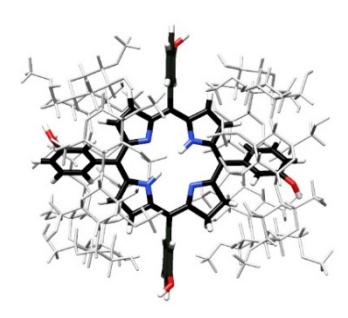
For this purpose, we have studied the influence of the $\beta$-CDs on mTHPC binding to the serum proteins, its accumulation, distribution and photodynamic efficiency in HT29 monolayer and spheroid models. In addition, the processes of mTHPC biodistribution in HT29 tumor bearing mice after intravenous injection of PS alone or with the $\beta$-CDs were compared.
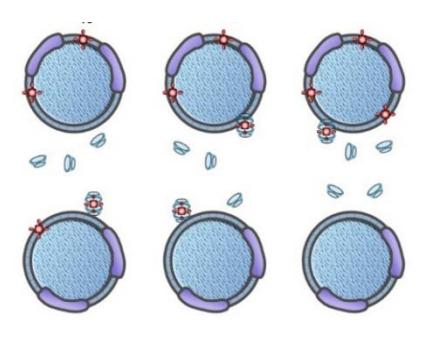
Interaction of mTHPC with studied $\beta$-CDs leads to the formation of inclusion complexes that completely abolishes its aggregation after introduction into serum [2]. The $\beta$-CDs increase diffusion movement of mTHPC molecules by nanoshuttle mechanism (Figure 1B). The presence of $\beta$-CDs significantly improve distribution of mTHPC tumor cell cultures in vitro [3]. In vivo studies confirm the fact that application of $\beta$-CDs allows to modify mTHPC distribution processes in tumor bearing mice.
The data obtained confirm the interest of CDs in mTHPC-PDT.