One of the most important factors determining the structure of electrodeposited Fe-W alloys is the composition of the deposited alloy. Increasing the W content, the structure of Fe-W electrodeposits changes from nanocrystalline to amorphous [1]. The interest in Fe-W coatings has grown in the recent years thanks to Fe-W properties such as hardness, corrosion resistance and thermal stability which makes Fe-W a potential substitute for hard chromium coatings [2]. The thermal stability of amorphous coatings is an important factor which can determine if the material is suited for high-temperature applications. In this perspective this work aims at studying the thermal stability of Fe-W coatings with various W content as well as the change in crystallographic structure, morphology and composition upon annealing.
Fe-W coatings were electrodeposited under galvanostatic conditions from Fe(III)-based glycolate-citrate bath with three different W content: 4at.%, 15at.%, and 25at.% of W. The coating deposited with 4at.% of W has a nanocrystalline structure in the as-plated condition, while the coatings with higher W content are fully amorphous as determined by X-ray diffraction analysis. Cross section imaging by scanning electron microscopy revealed the presence of cracks and oxygen rich areas inside the coating with low W content. The coating with high W content shows also cracks in cross section, but no oxygen was detected.
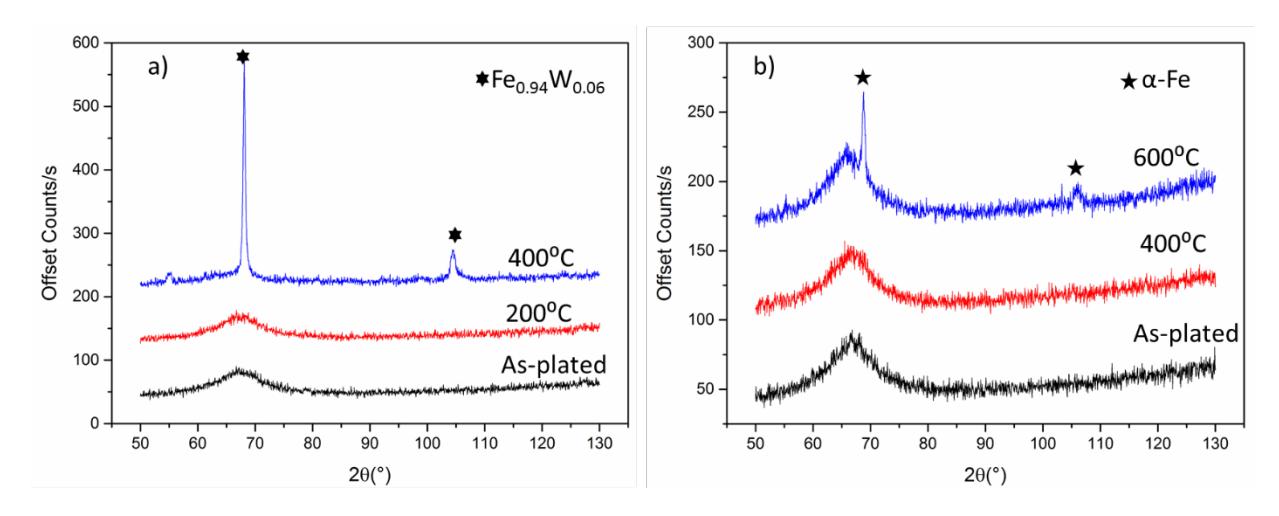
Annealing of the two amorphous coatings confirms that electrodeposited amorphous Fe-W alloys undergo phase transformation at elevated temperature. As shown in Fig. 1a, the Fe-W coating with 15at.% of W retains the amorphous structure up to 200°C and upon crystallization, a Fe-W solid solution is formed at 400°C. The coating with high W content instead retains the amorphous structure up to 400°C while a partially crystalized $\alpha$-iron structure is observed at 600°C (Fig. 1b). Hence, Fe-W coatings with higher W content (>25at.%) can be considered as suitable material for application at elevated temperatures.