
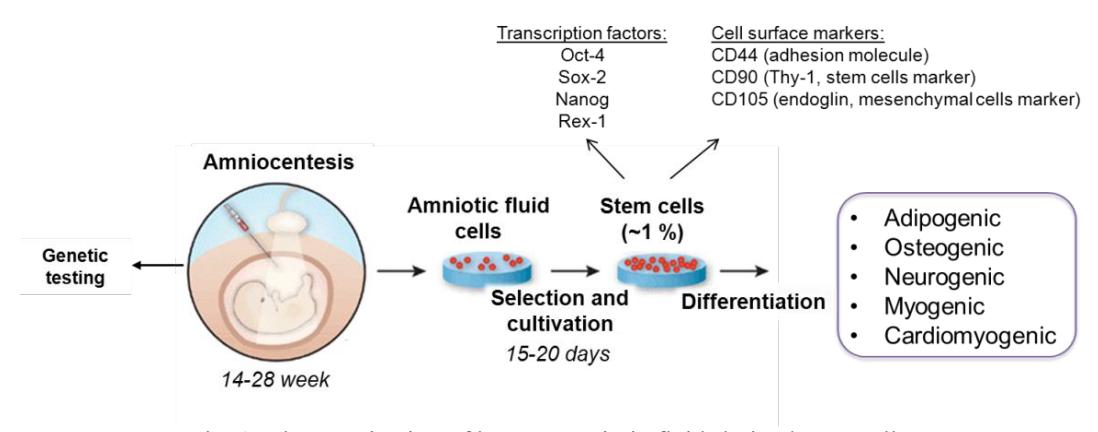
Human amniotic fluid-derived mesenchymal stem cells (AF-MSCs) are a new potential stem cell source for regenerative medicine and therapy. These cells are obtained from amniotic fluid by amniocentesis from pregnant women under the necessity of prenatal diagnostics. Amniotic fluid is known to contain multiple cell types derived from the developing foetus and extra-embryonic tissues including foetal skin, placenta membranes, epithelial and mucosa of foetal digestive, respiratory and urinary tract [1]. Among these, there is a fraction of cells exhibiting stem-cell like properties and characteristics of mesenchymal stem cells that were termed amniotic fluid-derived mesenchymal stem cells [2]. AF-MSCs have high proliferation and self-renewal potential and are able to differentiate towards multiple lineages in vitro, such as osteogenic, adipogenic, myogenic, neurogenic, etc. They show no evident antigenicity and tumorigenicity and can be obtained securely and avoiding ethical issues related to embryonic stem (ES) cells [3]. Considering these features, AF-MS cells are a promising subject for researches in vitro as well as in vivo.
The aim of our work was to characterize human AF-MS cells phenotypically, genetically and to assess their differentiation potential.
AF-MSCs were obtained from second trimester amniotic fluid from healthy women who needed prenatal diagnostics but no foetus abnormalities were detected by genetic analysis (protocols approved by the Ethics Committee of Biomedical Research of Vilnius District, No 158200-123-428-122). They were evaluated phenotypically as having typical spindle shape. Flow cytometry analysis revealed that AF-MS cells are strongly positive for mesenchymal cell surface markers CD105, CD90 and CD44 and negative for hematopoietic marker CD34 (Fig. 1). These cells also expressed pluripotency markers of stem cells, such as Oct4, Nanog, Sox2 and Rex1 as determined by RT-qPCR. AF-MSCs were also confirmed for their multilineage differentiation potential towards adipogenic, myogenic, neurogenic [4], osteogenic [5] and cardiomyogenic lineages by cell staining and expression of genes-markers.
In conclusion, our results complement knowledge about mesenchymal stem cells derived from human amniotic fluid confirming that these cells can be considered as multipotent stem cells and used for successful differentiation in vitro towards various lineages. This provides new insights for further investigations of human AF-MSCs and their applications in cell therapy and regenerative medicine.