
Series of optical systems scientific and technological issues can be solved with interference coatings. Researches include modeling and optimising processes of variuos optical coatings and their manufacturing methods. In these days polarizers have few problems: light beam displacment in Brewster-type polarizers and lower laser-induced damage treshold (LIDT) in absorbing normal incidence polarizers. Unfortunately, dielectric polarizers for normal incidence angle and high LIDT value can not be design using isotropic thin films. Anisotropic layers, namely sculptured thin films, have to be used.
The main aim of this work is to design multilayer coating from anisotropic single-layers and to characterize measuring reflection for different polarization, when illuminating the sample at normal angle. First of all, we explored extinction coefficient and refractive index dispersions of thin films, deposited at diffirent evaporation angles using Al2O3 and SiO2 materials. Secondly, we designed multilayer coatings, which transmission spectra features two mirror relfection areas, which occurs in different spectral region for different incident light polarizations. This transmission distinction perfectly describes polarizer properties.
In present work we use sculptured thin films, which was formed by electron beam evaporation. During the evaporation process columnar structures are formed on substrate due to the self-shadowing effect. This phenomenon causes porosity of thin films, which depends on evaporation angle. Multilayer coatings were formed using a serial bi-deposition (SBD) technique in which a tilted substrate is rotated stepwise by half turn about a normal axis during the evaporation of a material from a single source that causes a columnar structure to grow perpendicular to the substrate [1].
All processes were evaporated in high vacuum of $p_{0}$ = 1.7$\cdot$10-5 mbar. The evaporation rate was 3 Å/s for both materials and controlled by crystal quartz monitoring. Substrates were rotated in half turns about a normal axis every 5 seconds. The refractive indexes of Al2O3 and SiO2 thin films were determined by modeling transmission spectra using "OptiLayer" program.
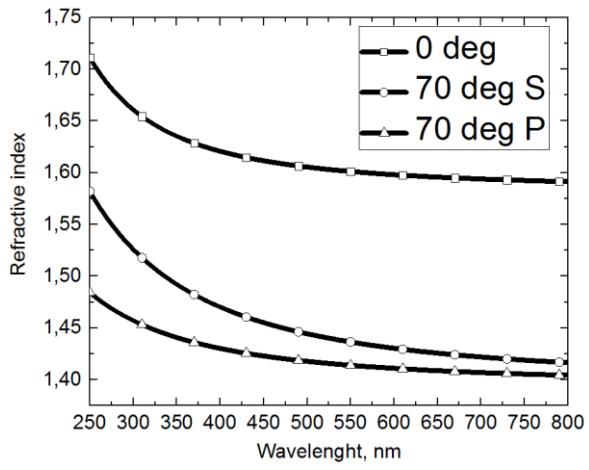
The dispersions of characterized refractive indexes of materials are represented in Fig. 1 Al2O3 and Fig. 2 SiO2. Anisotropic single-layers Al2O3 and SiO2 refractive indexes decrease due to porosity in thin films, formed by electron beam evaporation technique.
Thin-film polarizers for normal incidence angle is demonstrated. An advantage of the polarizers is compactibility with existing planar technologies. As an example, the thin film polarizers may be combined with spectral filters and diode detectors for simultaneous detection of color and polarization state. As well, variants of the coating may find many uses in laser optics, for example as polarization selective laser cavity mirrors.