Nuclear reactor graphite is a source of dangerous radioactive waste, it is particularly important to determine radiological characteristics of graphite as it is a part of nuclear power plant decommission process. Decommissioning of old reactors and planned use of graphite in the new ones force to look for solutions of irradiated graphite management and disposal [1]. There are several principal solutions possible: disposal of graphite in appropriate repositories, incineration of graphite as a combustible radioactive waste, or recycling and reuse [2]. In order to evaluate radioactive impurities in the graphite is need to burn the graphite. In this work the peculiarities for the burning of graphite were investigated.
Graphite was burned in the oven at 1000 °C in the He flow adding oxygen as oxidiser. It was determined that graphite didn't burn completely during one burning cycle. Burning bigger samples of graphite proved to a challenge for this method as it didn't completely burn down, even after running the cycle for few times. However smaller samples burned down completely. The burning results are presented in the Table 1.
| Sample nr 1. | Cycle Nr. | Mass of the released carbon, μg |
|---|---|---|
| 1 | 29.85 | |
| 2 | 34.38 | |
| 3 | 38.16 | |
| 4 | 30.77 | |
| 5 | 17.3 | |
| Total mass of carbon in the burned sample | 150.46 |
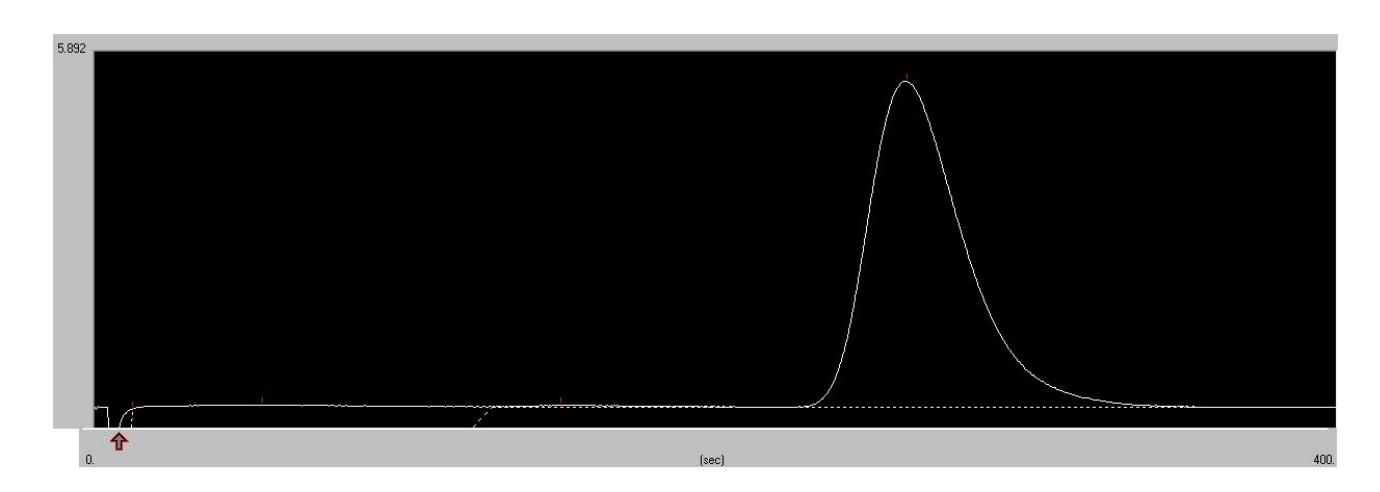
The amount of released carbon in the CO2 form was detected using thermal conductivity detector. The chromatogram of the burned graphite sample is presented in the Figure 1. Further investigations are needed to optimize the instant burning of the graphite sample.