
Silver and gold nanoparticles can be used for achieving so-called surface enhanced Raman scattering (SERS) effect. The SERS enhancement factor can reach 104 – 106. Interesting modification of SERS spectroscopy is SHINERS (shell-isolated nanoparticle-enhanced Raman spectroscopy). In SHINERS spectroscopy the same plasmonic nanoparticles as in standard SERS measurements are used but they are capped by very thin protective layer of SiO2, AlO2 or MnO2, that protects nanoparticles from contact with the sample and agglomeration [1]. If one uses a magnetic core in this type of nanoparticles (Fig. 1), application and removal from sample surface can be easier.
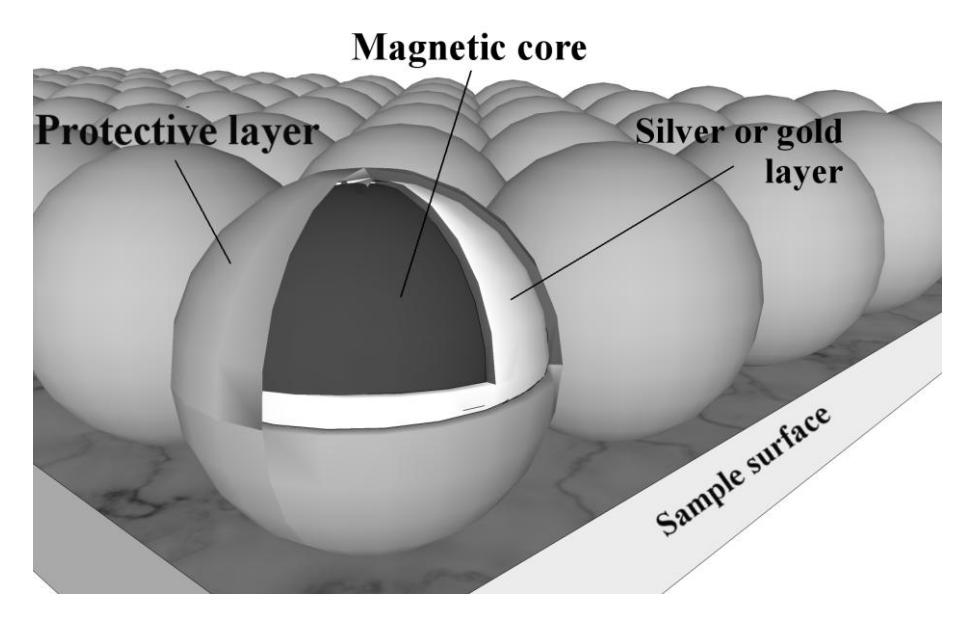
Synthesis of this type of material is not easy. Silver and gold is hard to attach to magnetic core. Strong magnetic effects are observed for ferric and cobalt oxide, which, unfortunately have different crystalline structure than gold and silver. So it can be necessarily to use silica for linking these materials. Next problem is that magnetic nanoparticles used as core can be too small to show a macroscopic magnetic properties for these nanomaterials.
In this approach we used methods from literature [2] for coating Fe3O4 by gold layer. In the other approach we are trying to use a silica layer on magnetic core for coating [3]. The silica layer may be relatively easy cover with gold or silver [4]. These silver or gold layers can be covered by next silica layer [5]
These multistage type synthesis is hard to make because problems on one stage can make all synthesis impossible to carry out but these type of material can be used for applications were normal SHINERS can't be used.