
The demand for new power storages for electric cars and electronic devices is increasing each year. However, the need for developing materials useful for such applications, coupled with concerns about the cost and availability of metals used in Li-ion battery cathodes caused invigoration of interest in the study of sodium-ion batteries. One of the most studied material of this type is Na3V2(PO4)2F3 with capacity up to 128 mAh/g at an average voltage of 3.75 V. Moreover, recently, it was shown that its capacity is not redox-limited, but, with high probability, site-limited [1]. Although mentioned material is considered as prospective, its capacity should be improved to be competitive with existed Li-ion cathodes.
The recent studies performed by J.E. Garbarczyk and co-workers have revealed an alternative method of the conductivity enhancement – thermal nanocrystallization of glassy analogs of the crystalline cathode materials [2, 3]. Glass systems, such as: V2O5, LiFePO4 and Li3V2(PO4)3 was obtained to verify this route. Ability of obtaining active cathode materials (without carbon additives) as well as simplicity of the sythesis are considered as main advantages of the performed process. In that case procedure consists of (i) glass preparation by melt-quenching (two-step method was used to obtain glassy samples) and (ii) thermal treatment of the glass to induce its nanocrystallization. Our previous studies have shown that an enormous and irreversible conductivity enhancement could be gained by the appropriate heat-treatment.
In this studies, we aimed to obtain Na3V2(PO4)2F3 glass from appropriate amounts of precursors (NaF, V2O5, NH4H2PO4), using two-step method similar to described in [4]. The batch was melted at ca. 1300°C in reducing atmosphere and rapidly cooled between two stainlesssteel plates (melt-quenching technique). X-ray diffractometry (Phillips XPert Pro) was performed to verify amorphousness of the samples, as well as to observe crystallization process upon heating procedure in Anton-Paar HTK 1200 furnace. In order to observe thermal events occurring in obtained samples, additional examination was carried out using TA Q600 apparatus.
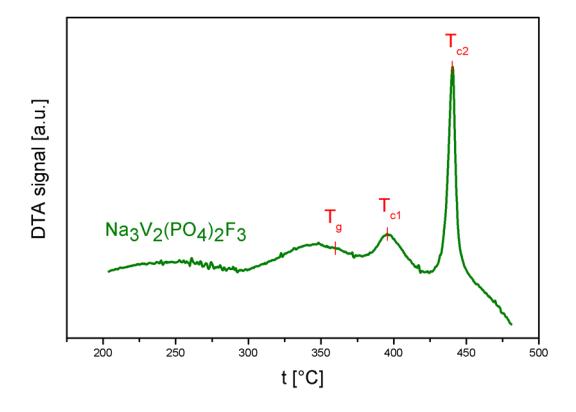
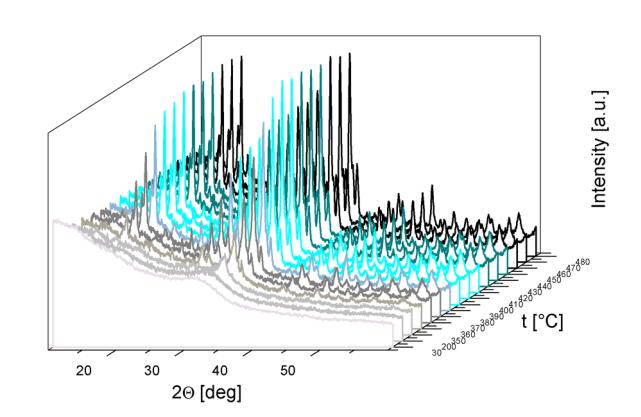
DTA trace for the obtained material proved to be typical for amorphous materials. The temperatures of glass transition (Tg) and crystallization (Tc) were 359°C and 465°C, respectively (Fig. 1.). This outcome corresponds to the XRD results, which consisted only in amorphous halo (Fig. 2.). Temperature dependent XRD measurements, conducted in nitrogen atmosphere, showed that heating the glassy material to the temperature higher than Tc resulted in crystallization in NASICON-like phase (ICDD card no. 04-012-2207). The average size of grains was estimated using Sherrer's formula to be within 40–60 nm range. Performing further examinations should reveal the answer, whether the influence of nanocrystallization process results in enhancement of electrical properties of examined material.