
During last decades magnetic nanoparticles (MNPs) have attracted a lot of attention in different fields of industry, medicine and engineering [1]. Among them, MNPs based on magnetic iron oxides and ferrites are of great importance due to the possibility to tailor in a wide range the shape, size and magnetic characteristics of nanomaterials by varying synthesis conditions. Among other ferrites, magnesium ferrite (MgFe2O4) is of particular interest due to its high resistivity, photoelectrical properties and uniform characteristics [2]. However, the saturation magnetization of magnesium ferrite is quite low. One of the ways to increase ferrite magnetic properties, such as saturation magnetization, is thermal treatment of the nanoparticles. At higher temperatures a redistribution of metal ions in tetra- and octahedral sites occurs, which may result in the increase of magnetization.
For such applications as catalysts or adsorbents it is very important that nanoparticles have large surface area and saturation magnetization, so that the particles could be magnetically separated from the reaction media. One of the ways to produce ferrite nanoparticles with a high surface area to volume ratio and uniform size distribution is spray pyrolysis of inorganic metal salts solution. Further calcination of the produced MNPs results in the increase of crystallinity and magnetic properties. However, thermal treatment of the MNPs during both synthesis and calcination steps leads to the sintering of the particles and, therefore, to the decrease of the surface area.
In this work, magnesium ferrite nanoparticles were prepared via spray pyrolysis method in a nitrogen atmosphere at 700 °C from a solution of magnesium and iron nitrates taken in stoichiometric ratio and then annealed at different temperatures (400, 600 and 800 °C) to increase crystallinity and saturation magnetization of MNPs. Inert component of NaCl was added to precursor solution to prevent MNPs from agglomeration during pyrolysis and thermal treatment. After the annealing NaCl was removed by washing with deionized water. The morphology and phase composition of the MNPs was studied with XRD and SEM/TEM analysis, and magnetization curves were recorded at room temperature. The aim was to increase saturation magnetization of magnesium ferrite particles without a significant agglomeration of the MNPs during annealing.
Fig. 1. represents TEM images of the MNPs after annealing at different temperatures and removal of NaCl matrix. For the samples annealed at 400 and 600 °C all the MNPs have a narrow size distribution with no significant increase in diameter as compared to as-prepared MNPs. For the MNPs annealed at 800 °C the size distribution is less narrow and partial recrystallization leading to cutting of MNPs takes place. However, the number of inter-particle contacts is very low and NaCl matrix well prevents MNPs from sintering even at such a high temperature.
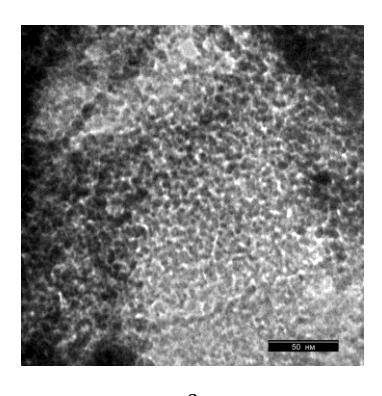
The average nanoparticle size values for MNPs annealed at 400, 600 and 800 °C were found to be around 10 nm, 20 nm and 30 nm (majority fraction), respectively. The saturation magnetization value of MNPs, however, increased significantly during annealing: from 14 emu/g in case of annealing at 400 °C to 22 and 29 emu/g for 600 and 800 °C, respectively. This proves the pyrolysis with sodium chloride and further annealing in NaCl matrix to be a good way to produce non-aggregated ferrite nanoparticles with high saturation magnetization value.