
Spectrometric parameters and dimensions of device was developed allows its application in non-laboratory conditions. Device has sizes 160 x 80 x 55 mm. Spectrometer is battery powered, so external electrical socket it not required. Work time of spectrometer using battery is more than 4 hours. Spectral range of this device is 400-720 nm. The range covers most requests of biological issues [1, 2]. Main objects for application of this spectrometer are plants. Most chromophores of plants luminesce in visible range and there are no significant narrow spectral peaks, so spectral resolution of device was developed (2 nm) is enough for accurate experiments [3].
The most distinguishing feature of the spectrometer is way of data transmitting from spectrometer to system of spectra visualization. Bluetooth module HC-05 sends spectral data to some computer data system (CDS). Using wireless way of data transfer makes spectrometer completely portable. Baud rate of transmitting is 921600, it means obtaining of 2 spectra per second at CDS.
There was written app for Android and program for personal computer to visualize, save in dat file and work with spectral data. Also, the app allows choosing of exposure time and snap-shot/active mode regimes. Examples of obtained spectra on smartphone screen shows on Fig. 1.
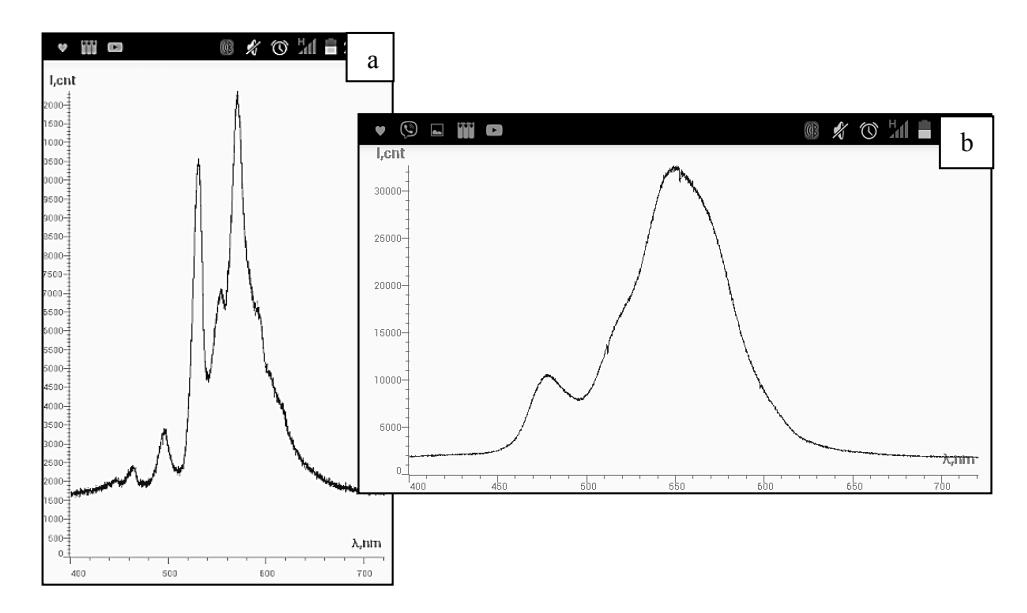
During experiment we can obtain reflection spectrum or transmission spectrum. Providing experiments in situ (field, forest, any non-laboratory conditions) means, that excitation source is Sun or some portable source. That is why two type of excitation led-source was made. Each led-source made in ring-geometry with hole in the center for simple connection between spectrometer and led-source ring. Wavelength of these modules is 470 nm and 655nm.
Spectral characteristics of plans and tooth enamel was analyzed based on spectral data obtained using the device. Cost of the device extremely small but it's characteristics can compete with global peers.