
Surface enhanced Raman spectroscopy (SERS) is an ultrasensitive analytical tool which finds numerous applications [1]. Therefore, an important and urgent task is to search for parameters that affect SERS enhancement factor as well as to develop of effective nanostructured SERS-active metal substrates [2-4].
In this work the effect of the mutual configuration of the analyte with different photostability and the gold nanoparticle films on the intensity of the SERS signal was investigated. The excitation wavelengths was $\lambda = 531$ and 632.8 nm. A monodisperse sol of gold was obtained by Turkevich's method [5]. The SERS-active films were formed on glass substrates by layer-by-layer electrostatic deposition of gold nanoparticles. The Raman spectra of malachite green and mitoxantrone on the gold nanoparticles were investigated in three configurations: above the gold film, under the gold film, and between the gold films (so called "sandwich" configuration). The 3 μL of each analyte (0.8·10-5 M aqueous solutions of malachite green (tetramethyl-4,4-diaminotriphenylmethane chloride) and 1.3·10-5 M mitoxanthrone (1,4-dihydroxy-5,8-bis[[2-[(2-hydroxyethyl)amino]ethyl]amino]-9,10-anthracenedione dihydrochloride) was dropped atop gold plasmonic film or pure glass. In the cases of "analyte under gold film" and "sandwich” configuration the gold sol was dropped atop analyte layer and dried.
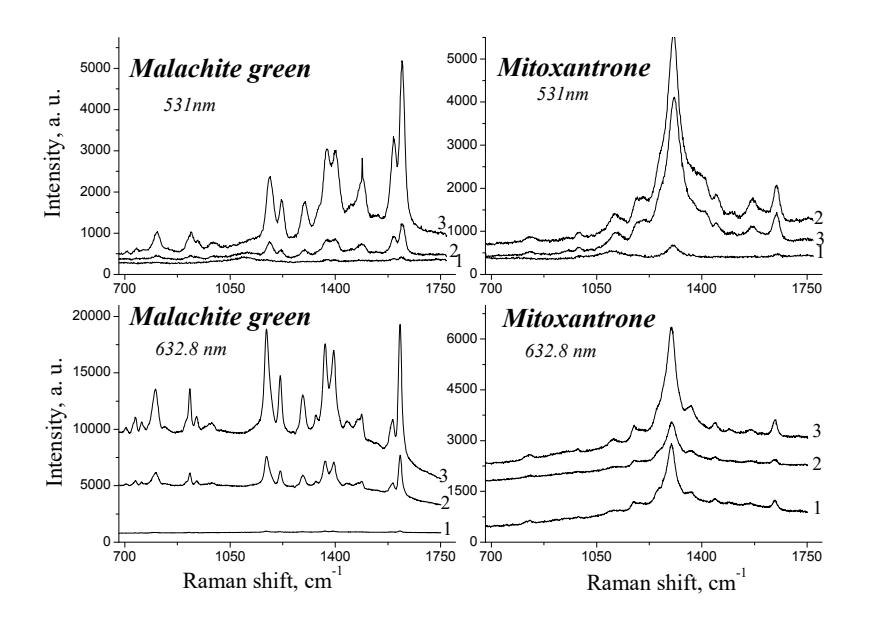
Thus, it was shown that the SERS intensity of the analyte in a sandwich configuration is up to 5 times higher compared to the "analyte under gold film" arrangement and up to 60 times higher than for the "analyte on gold film" case with the using of excitation emission in the plasmon resonance region (531 nm and 632.8 nm). Moreover, the effect is greater, the less photostability of analyte and the higher the power of the exciting radiation. The reason is that the layer of metal nanoparticles above reduces the access of oxygen to the analyte, preventing photodegradation of the molecules.