
Various acids transformation from fluids and water to clean water and harmless product is challenging task. It takes into consideration not only chemical reaction, but technological process [1], designed [3] and various dependencies from system parameters to be useful and adaptable in practice.
We consider the following chemical reactions taking place in the micro-reactor visualized at Figure 1a:
$$L + E_{1ox} \xrightarrow{k_1} P + E_{1red}, \quad E_{1red} \xrightarrow{k_2} E_{1ox} + 2e^-\tag{1}$$$$E_{2ox} + 4e^{-} \xrightarrow{k_3} E_{2red}, \quad E_{2red} + O_2 \xrightarrow{k_4} E_{2ox} + H_2O\tag{2}$$where L is laccase, O2 - oxygen, H2O - water, Ei(ox) and Ei(red) are the oxidized and reduced forms of the enzyme Ei, i = 1, 2, P - reaction product, k1 and k4 are the rate constants of the enzyme reactions, and k2, k3 are the rate constants of the electron transfer (ET) reactions.
It is assumed that both enzyme catalyzed processes (1)-(2) obey the Michaelis-Menten kinetics.
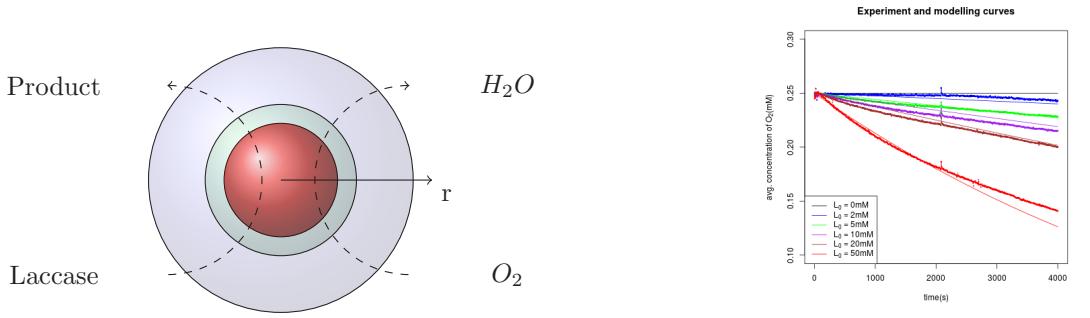
Due to non-linearity of the governing equations of the problem, no exact analytical solutions are possible. Because of this, the initial boundary value problem was solved numerically by applying the finite difference technique [4]. The numerical simulator has been implemented in C++ programming language.
In physical experiments oxygen parameters were measured since system does not have electrode layer [2]. Initial concentration of laccase varied between 2 and 50 mM. Experiments data was compared with simulations see Figure 1b.
A mathematical model of micro-reactor was created and implemented. Results showed that the relative difference between the numerical solution and the experiment data, averaged over time from 0 up 4000(s), was less than 10% for all experimental concentrations of laccase. Since such modelling errors including the measurement errors can be considered as admissible, the model can be used for investigating the kinetic peculiarities bioreactive system.