One of the most important problems in modern laser physics is the optimization of laser structure and operational regimes relative to concrete range of applications. For a comprehensive solution of such problems it is necessary to utilize rather detailed theoretical models [1].
There are two types of approaches that usually are exploited in practice. The first one, which is usually named as a point (or averaged) model, uses variables averaged over a resonator volume to consider laser dynamics problems. This kind of model is evidently acceptable in the case when variables distributions over the resonator volume are near to a uniform one. The second type of models (the so-called travelling wave approach) can be appropriate for strong inhomogeneous distributions of laser variables, but the known models consider only steady-state regimes [1, 2].Today, space-distributed (the second type) model is the most detailed that we could handle.
But at the same time when using this model there is another problem - the complexity of the calculations.
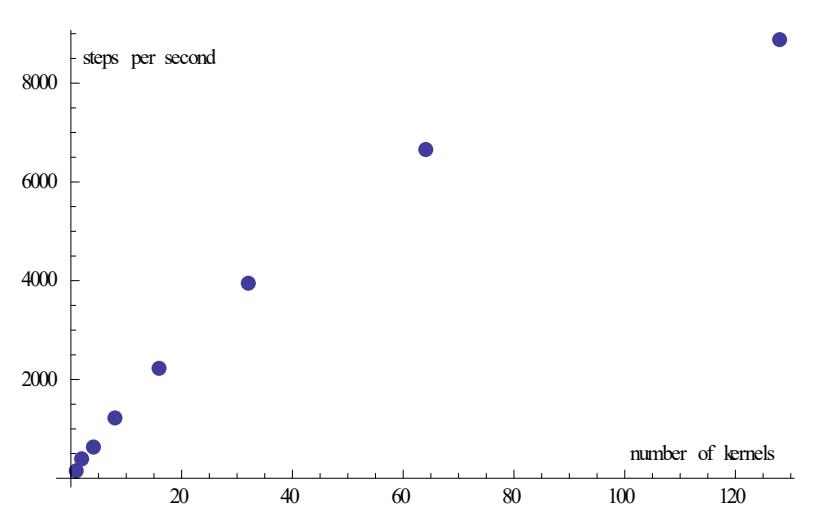
Using parallel evaluations is one of the ways to solve this. This way could be reached great increasing of calculation powers. Results of implementation parallel evaluation in research of radiation dynamics of space-distributed model solid-state laser with high definition presented in Fig. 1.The same system were solved with different number of kernels that took part in evaluation.