
Water plays key role in many chemical and biological proccesses, exhibiting unique properties in many aspects and applications. Central role in the ungerstanding of these properties plays ability of the water molecules to form hdrogen bonds and cluster structures. Water molecule is known for its ability to form at least four hydrogen bonds – two as asseptor and two as donor. With this, spectral, structural and energetic perturbations introduced by the formation of hydrogen bonds, are growing non-linearly with the number of hydrogen bonds for single molecule. These cooperative effects are poorly investigated, although they can be responsible for some unque water properties.
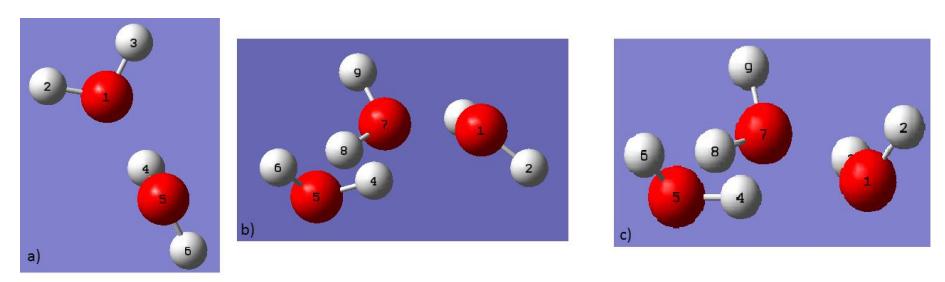
Equilibrium configurations of some water molecules clusters, as well as their conforamtional diversity were calculated at B3LYP/cc-pVTZ level of theory. For obtained configurations IR and Raman spectra were calculated at the same level of theory. Both type of calculations were performed for 1) free clusters, 2) clusters in Ar, 3) clusters in water. For the second and third cases, the PCM model of taking into account the solvation effects was used. Besides, based on computational facilities, for some cases IR spectra were calculated both in harmonic and anharmonic approximations. Equilibrium configurations of water dimer and trimer are presented in Fig.1.
Calculated IR spectra of the water trimer presented in Fig. 2.
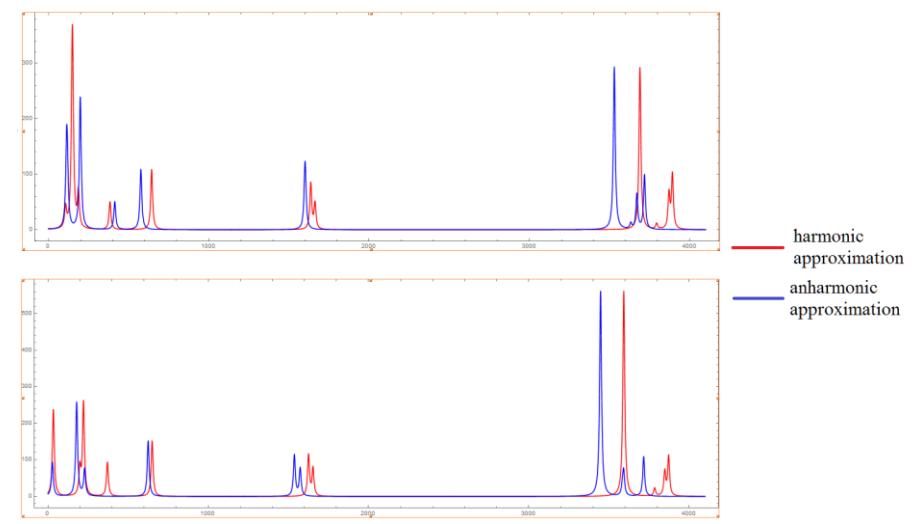
As can be seen from Fig.2, accounting of the anharmonicity effects leads to the red-shift of the stretching and bending vibrations of the hydroxyl groups of water monomers, and in case of water dimer value of this shift indicates insignificant increase of anharmonicity of the donor O-H bond comparing to the free one. For water dimer in water, additional red-shift of the stretching vibrations can be noted. In forthcoming presentation investigations of the IR spectra of water clusters with different number of molecules will be introduced. Influence of intrinsic anharmonicity of vibrations and medium polarity on the positions of the absorption bands will be analyzed.